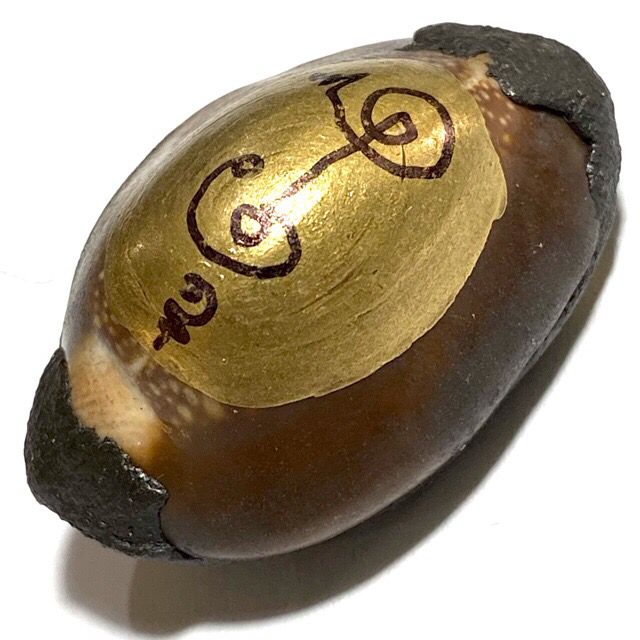
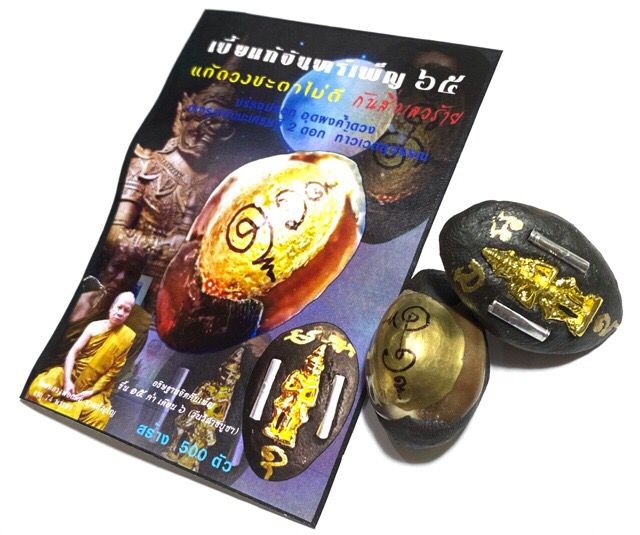
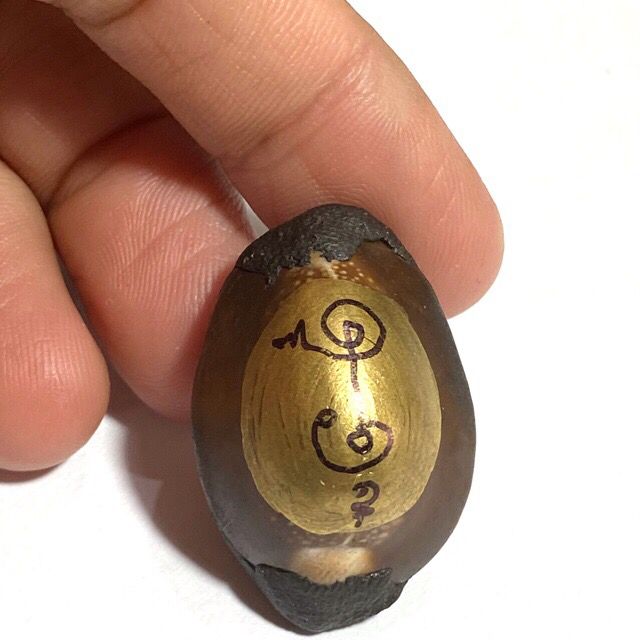
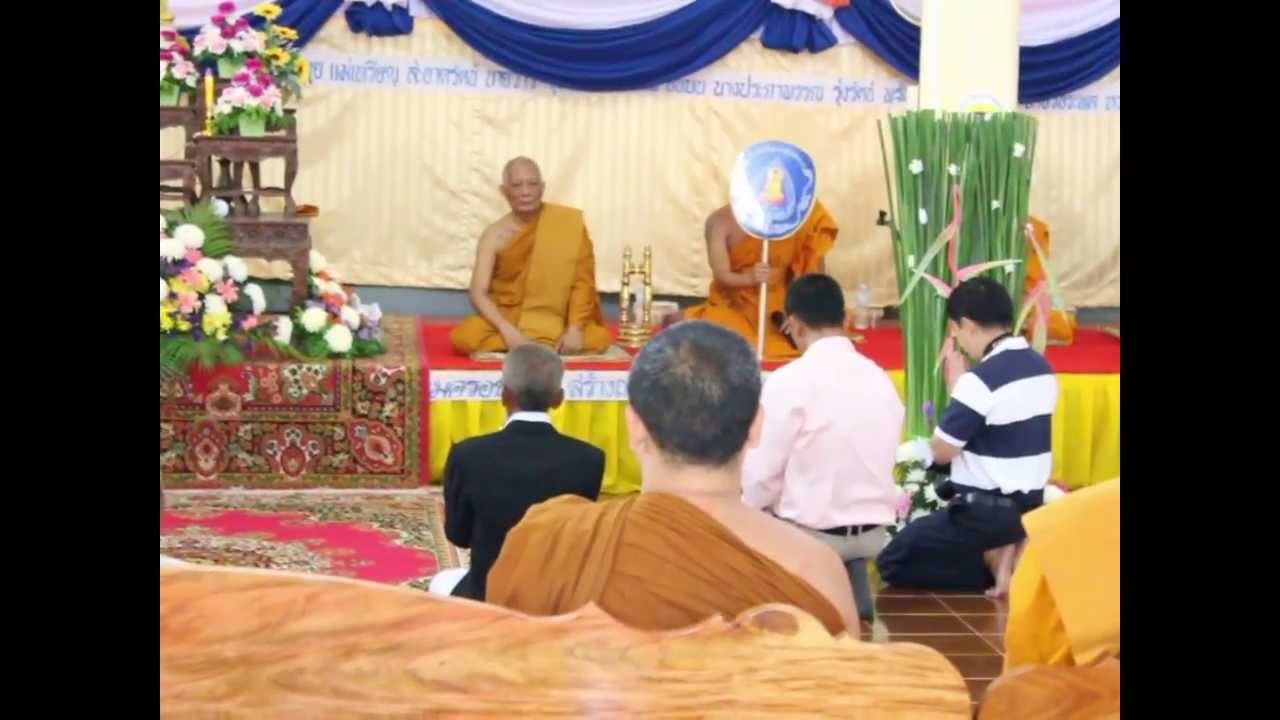
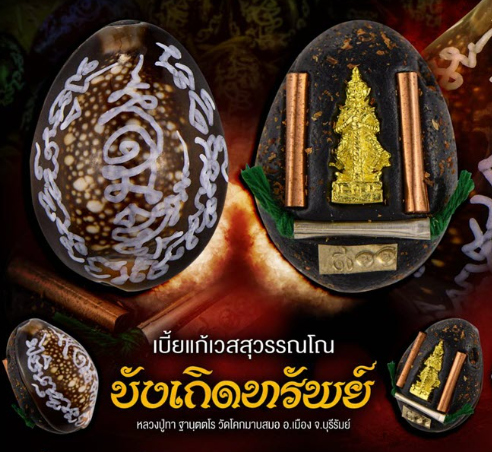
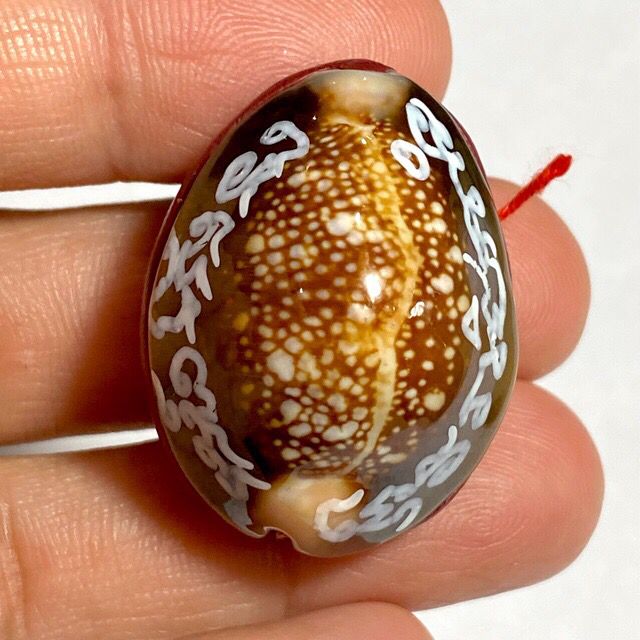
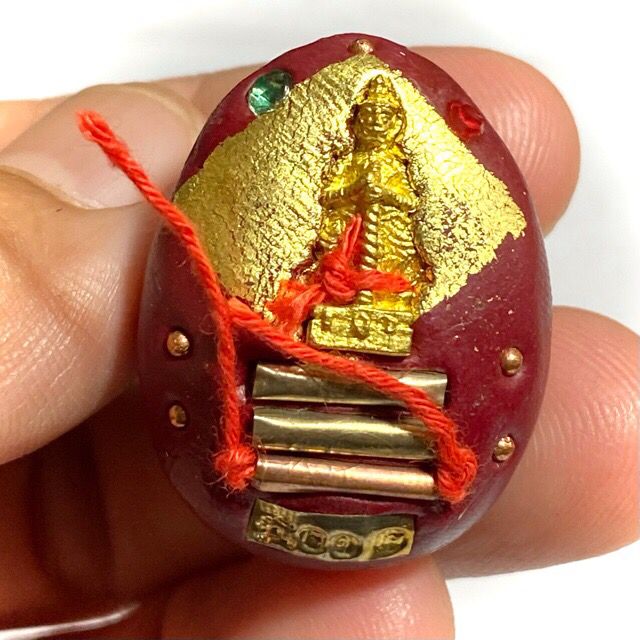
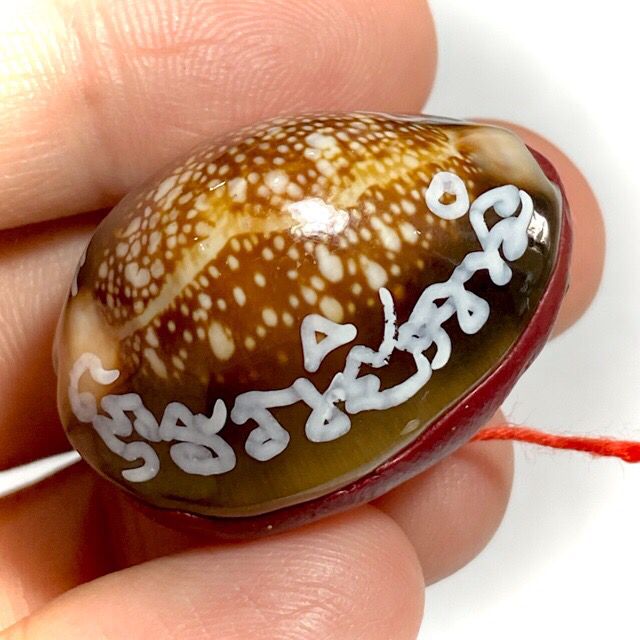
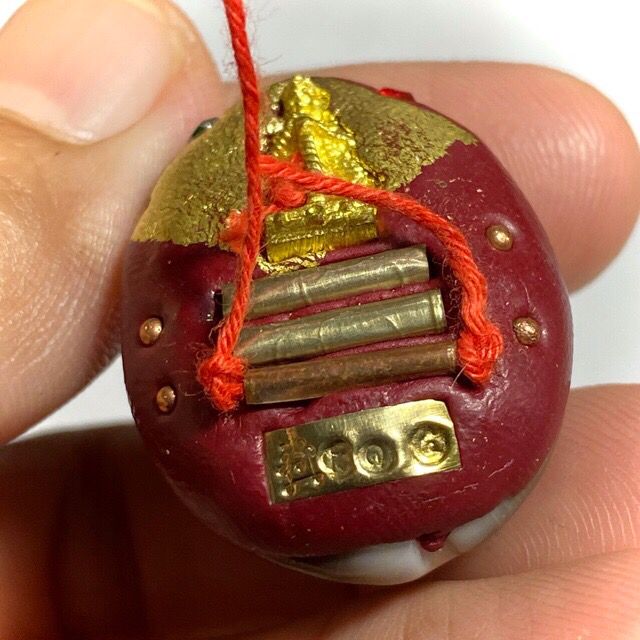
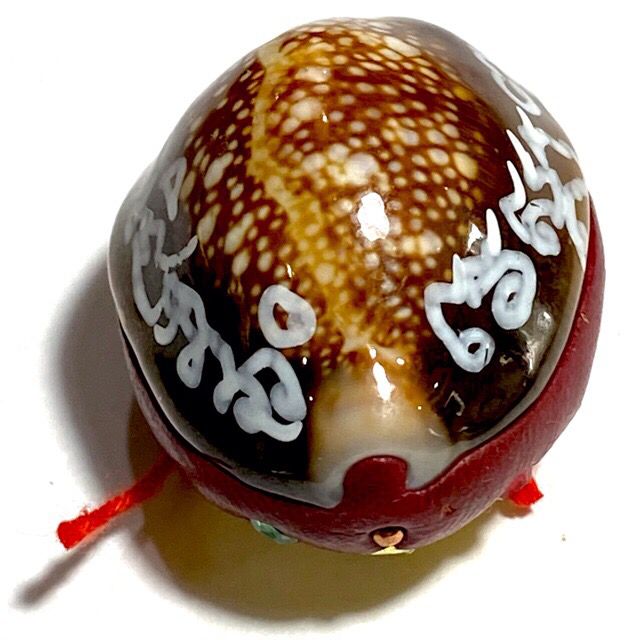
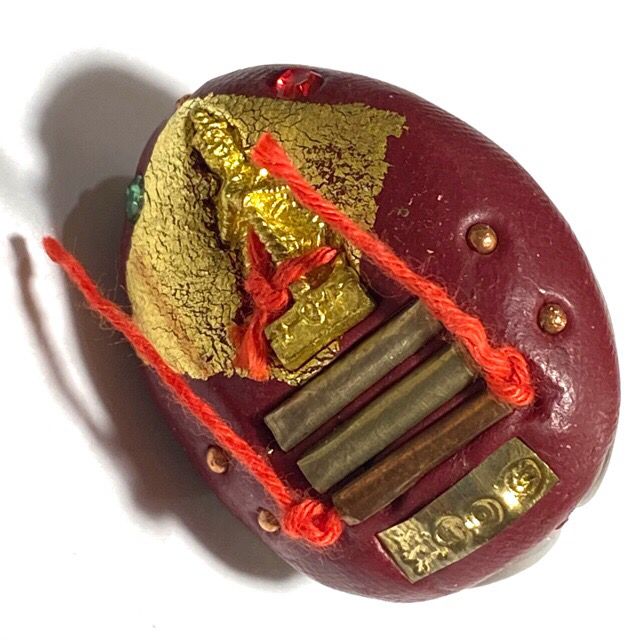
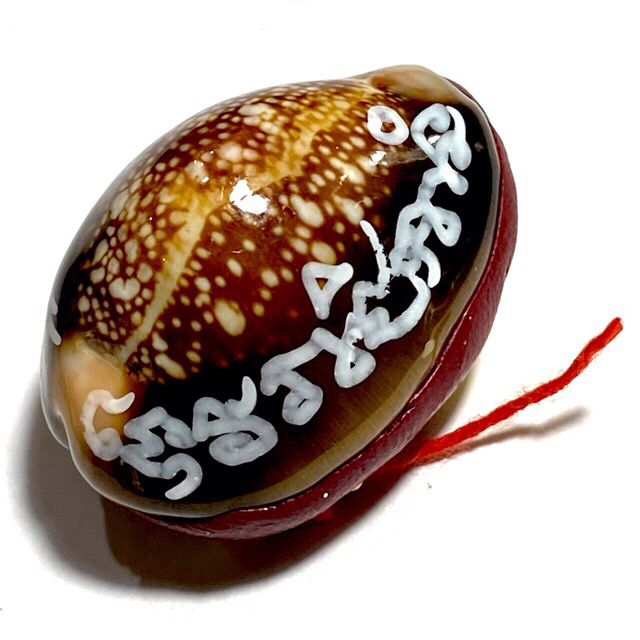
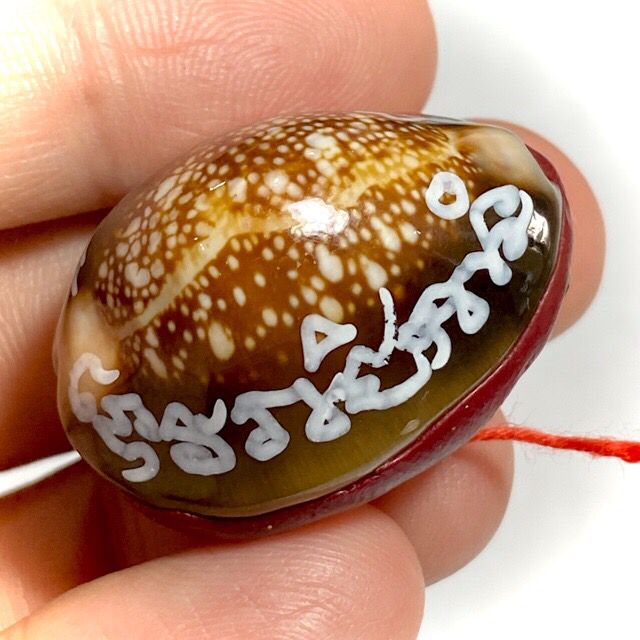
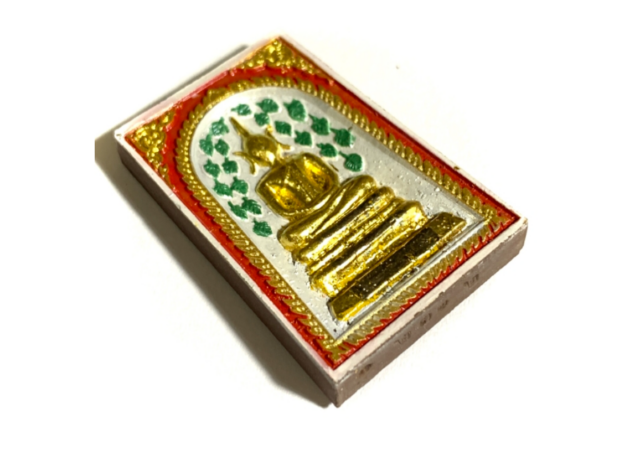
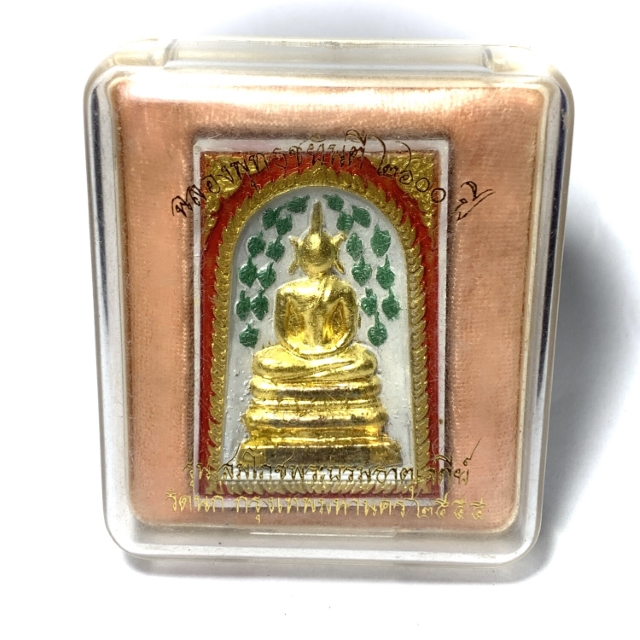
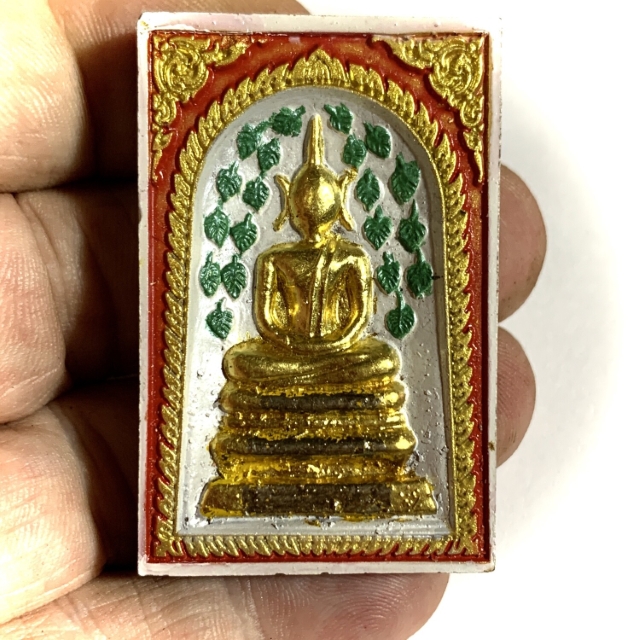
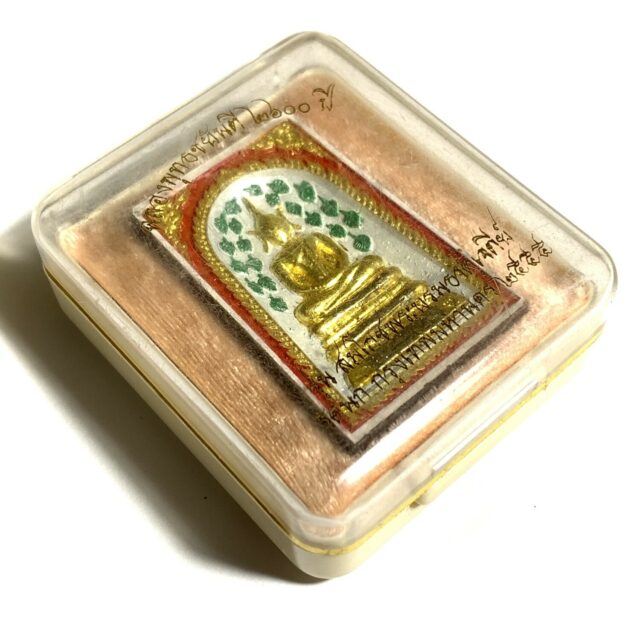
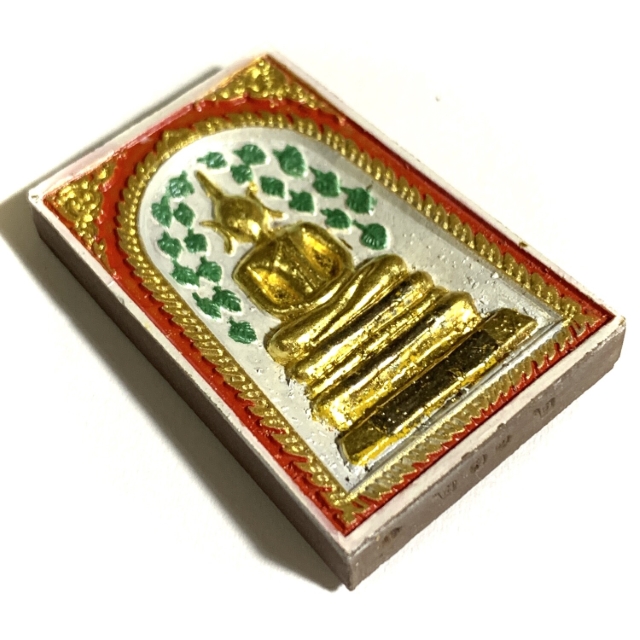
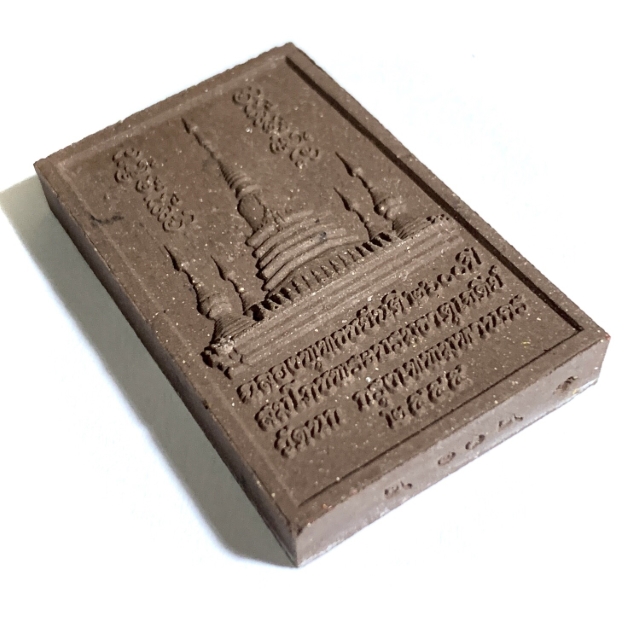
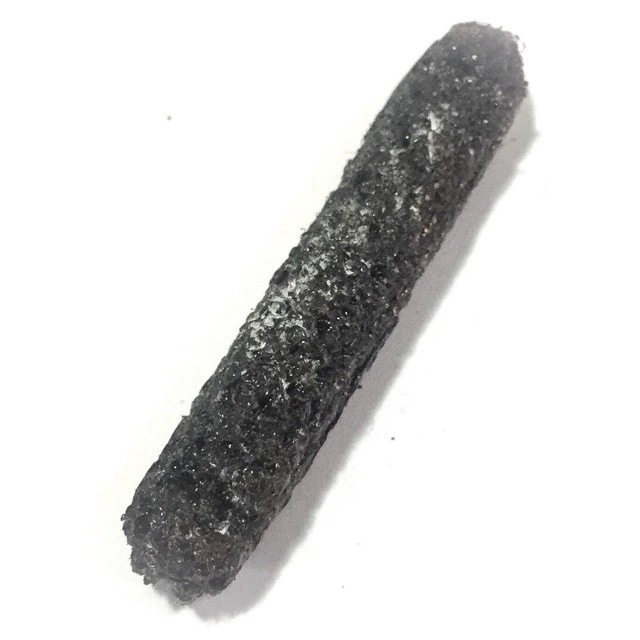
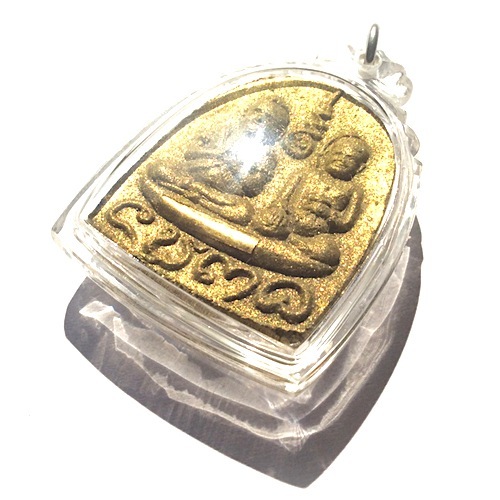
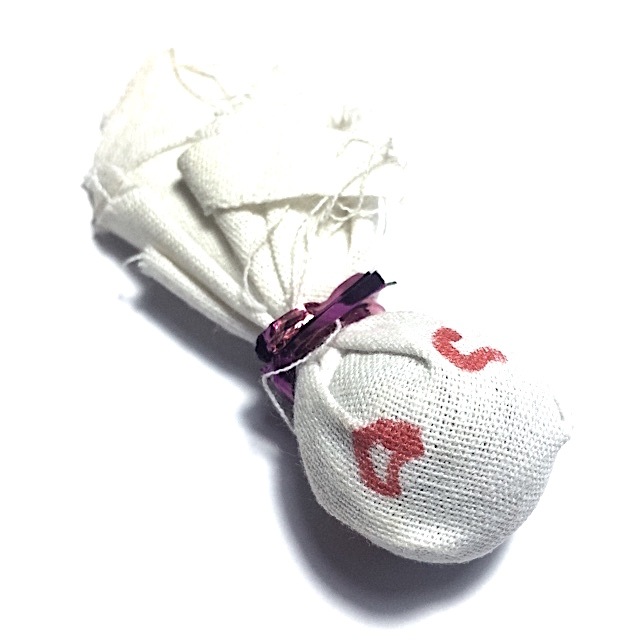
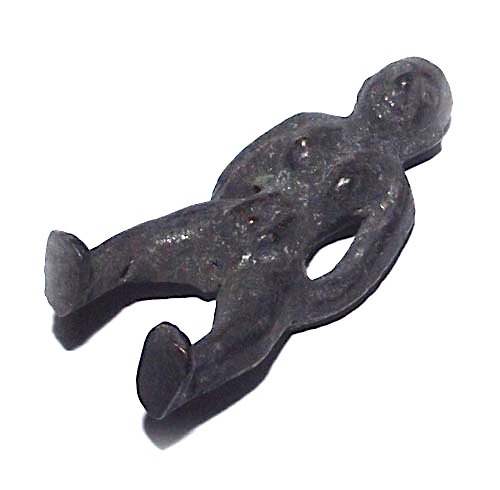
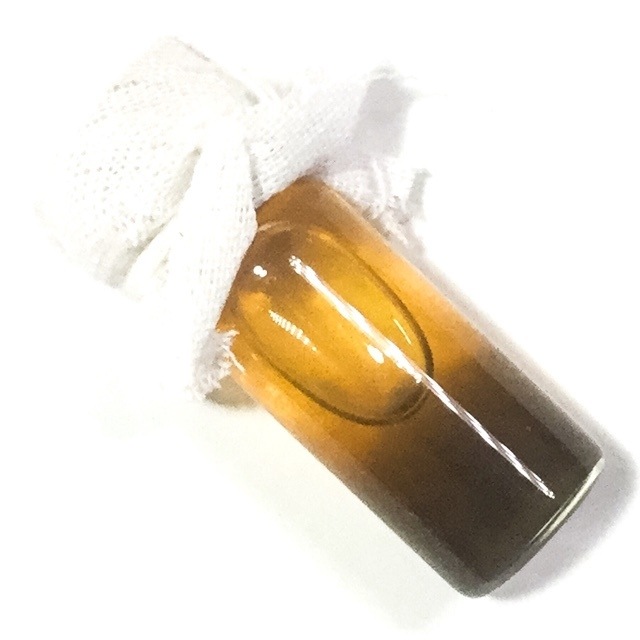
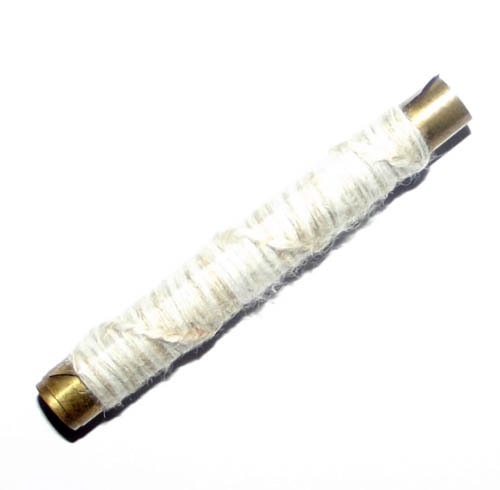
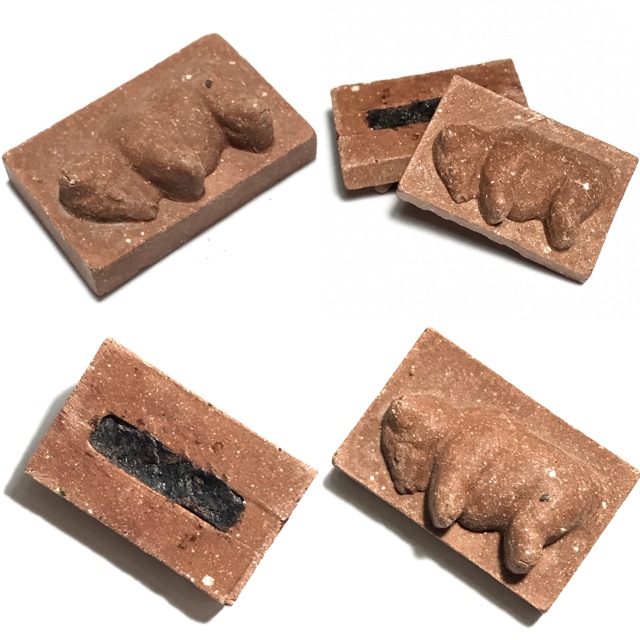
Special Ongk Kroo Model of the Daw Sethee Millionaire Star amulet, made from the world famous powerful Lek Nam Pi anmd Rae Serm Palang Gaay Libido and Health increasing Muan Sarn sacred Powders, with Look Namo spell metal slug, Solid Gold Takrut inserted into the rear face, from the Great aged forest tradition Master Monk, Luang Por Simpalee, of Wat Pha Mara Wichai (earlier resident at Wat Tham Wua Daeng). Extremely few of these amulets Were made in his Daw Sethee 2nd edition.

You can find the Daw Sethee Millionaire Star amulet here. This amulet was released in the 2nd Daw Sethee edition (Click here to view in store) of 2554 BE. The Daw Sethee edition (Click here to view in store) was world famous for the release of slver Lek Lai and Lek Nam Pi/RTae Serm Palang Gaay powders star amulets, crafted in the style of Luang Por Pina. The edition also included some Lek Lai Ngern Yuang Pyramids filled with Sacred Muan Sarn powders, which are among the most highly sought after of all LP Simpalee’s amulets, as well as the hardest to find.

These amulets were made with Luang Por Simpalee’s now World Famous ‘Rae Perm Palang Gaay’ powders, which possess Healing Powers, to Improve Health, and Increase Physical Libido/Stamina. The amulets were Made in 2562 BE, Empowered for 2 Years, with extra empowerment from Luang Por Adithep, and Released along with amulets of the 2564 BE Duang Sethee Edition

A Powerful Sacred Powder Amulet for Maha Pokasap, Maha Lap, Siang Choke, Maha Sanaeh, Metta Maha Niyom, Jerajaa, Kaa Khaay, Siang Choke and Gae Aathan

Luang Phu’s amulets have increased in popularity around the country, and south east Asia, and even to Buddhists and Practitioners of the Occult in the Western World, after it became Nationally known that his amulets have real power, and furor was set loose, causing his amulets to increase in price and rarity since many years already.

YouTube player

Luang Por Simpalee’s amulets are famously reputed for their power to work with all devotees, and to give sure results .The Buddha taught us that nothing in Life is Certain, but the amulets of Luang Por Simplii, are as close to a certainty as one could possibly get with an Amulet in this Era. His amulets are now extremely sought after, and very difficult to encounter, due to immense demand from devotees around the world.

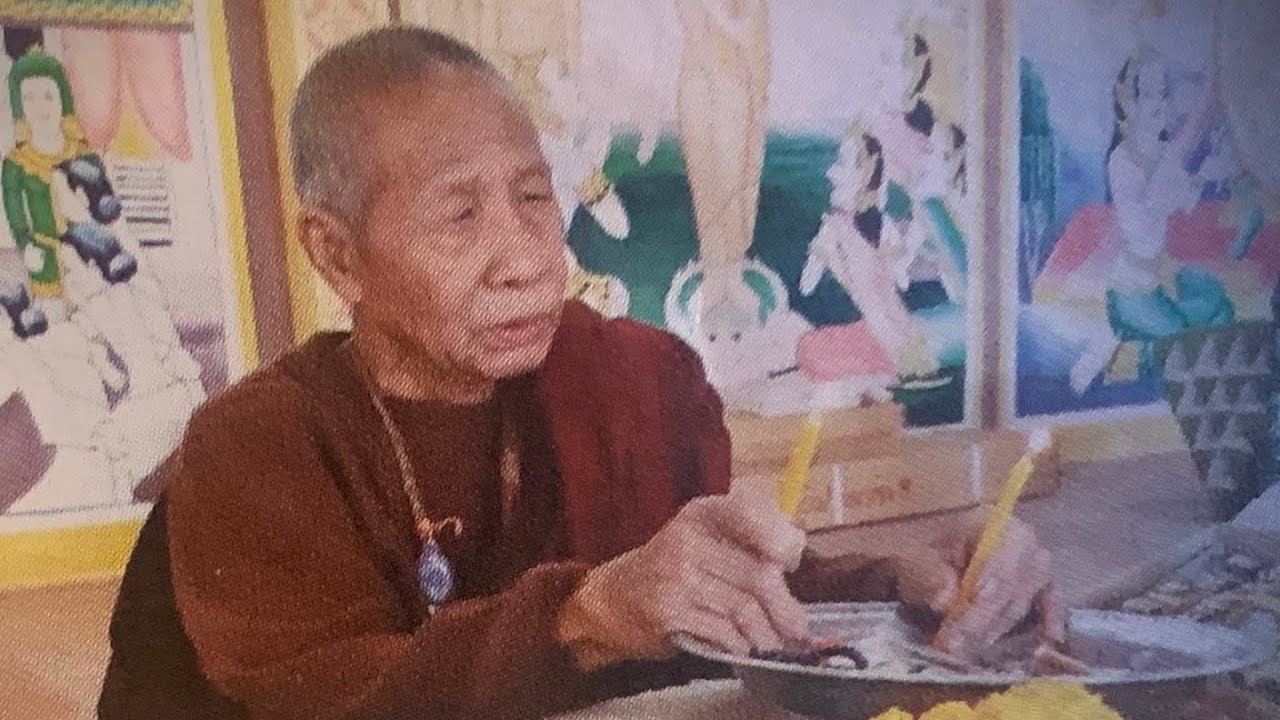
Few Masters can reflect such an amazing trajectory these days, and few can display such easily visible miraculous traits of meritorious practice. One of the last remaining direct Looksit of Luang Phu Mun, and one of the last remaining Masters of the previous Generation of Guru Monks to remain with us.

This Grand Master of over 122 years old (written 2024), is now highly in demand for his extremely powerful and authentically made Amulets. Luang Por Simpalee’s extreme attention to detail and faithfulness to the authentic methods of applied Magical Wicha Saiyasart, have made his amulets among the most highly sought-after in the present era.

His affinity and power to call the Magical Lek Lai Kaya Siddhi elemental substance, is renowned throughout the country and in various other countries of south-east Asia. His use of ground up powdered Lek Lai substance in the Muan Sarn Sacred Powders used for his Amulets, has become truly a trademark, as well as his use of Rae Perm Palang Gaay sacred herbal ingredients which have the power to heal a multitude of illnesses and mortal afflictions, and increase Libido.


This edition of amulets were made using the highest concentration of Lek Nam Pi Powders Possible, with ‘Rae Perm Palang Gaay’ Powders being the sole other ingredient. This makes the amulets powerful for the presence of LP Simpalee’s famous Rae Serm Palang Gaay Libido Increasing and Healing Powders, and Lek Nam Pi Kaya Siddhi Elemental Adamantine Substance.
The Sacred Powder Amulets in this edition, were made with a high grade of Muan Sarn, using high quantities of the two most powerful essential magical substances. The Powder was made by taking the sacred famous ‘Lek Nam Pi’ Adamantine Kaya Siddhi substance from the Holy Cave, and powdering it up grinding it up with Pong Rae Perm Palang Gaay Libido Increasing Magic Powder, and other Muan Sarn Sacred Powders using Powerful Magical ingredients, according to the Formulas of Ancient Wicha possessed by Luang Por Simpalee.

These amulets, use an almost pure formula of the Lek Lai Powder, along with Luang Por Simpaslee’s Famous ‘Rae Perm Palang Gaay’ Health and Libido Increasing Powders. The Lek Lai used for the powders was called from a Holy Cave, and then using Alchemy was transformed from solid earth elemental substance into flowing liquid Water Elemental subnstance, and cast into blocks, as well as into the shapes of amulets. Each amulet has a series inscription stamped on the front face of the amulet.

The Lek Lai pieces and Lek Lai powders were then given to Pra Ajarn Geng of Wat Khao Tham Pra Cave Temple, who is an Adept Master of calling the spirit of Lek Lai Kaya Siddhi Elemental Substance and to Empower it. After this, the Lek Nam Pi Powders and Lek Lai were brought to Ajarn Ongk Por Jidtra, at Pak Chong in Nakorn Rachasima, who possesses the Wicha to awaken all the magical powers within the Lek Lai, to bring protective magic, as well as prosperity improving powers. After this, Luang Por Simpalee took the powders to his temple, and performed a full five months of empowerment on a nightly basis, completing the invocation and empowerment process for the Lek Lai Powders to possess true power. Then the powders were mixed with Rae Serm Palang Gaay Powder, and used to press the Amulets.

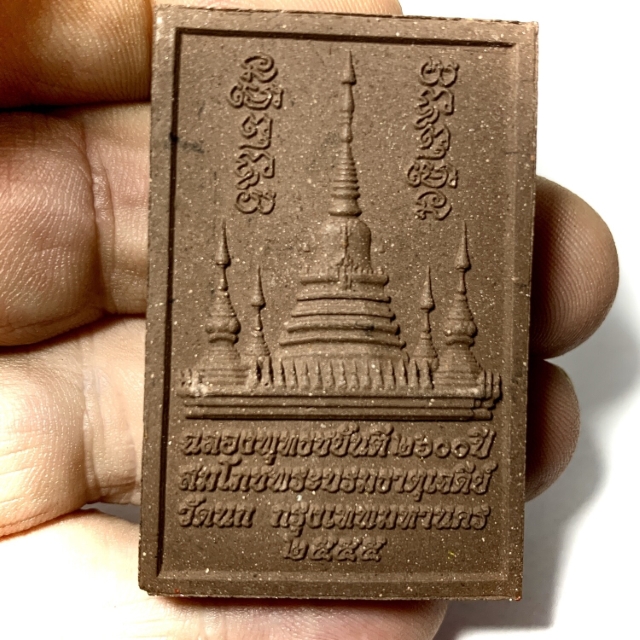
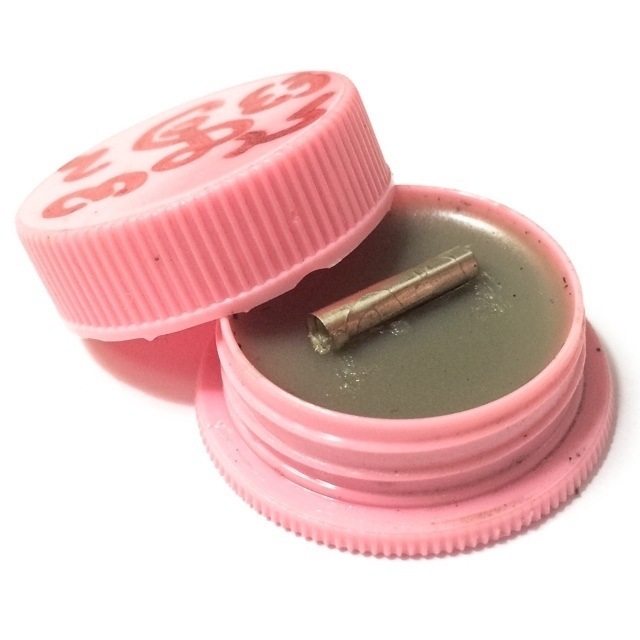
Below; Sacred elements inserted into the rear face of the amulet, made from rich Lek Nam Pi and Rae Serm Palang Gaay Sacred Muan Sarn powders

YouTube player

The front face of the amulet features an 8 pointed star, with sacred geometrical connotations, and the Wicha of the Daw Nai Pan Nai Pon of LP Pina, imbued to boot which is covered in gold powders, applied with sacred oils.

This grand-master, is now at the extreme old age over 120 years old (in 2025), and was ordained by the great Arahant Monk, Luang Phu Mun himself, back in the days when he was still walking the forests of Thailand, and creating what is now known today as the most authentic and direct practice which is more similar to that of the time of the builder of all Buddhist Dogmas: the Tudong Forest Tradition.

Luang Phu Simplee is the living Master of this Lineage, with direct Initiation through the hand of Luang Phu Mun. The Forest Tradition of Tudong was in fact actually not even really a dogma, for it is better denominated as an applied method of practice, more than a method of philosophy, or philosophizing. This is perhaps one of the only last remaining Masters living memory whose direct lineage transmission from this era of masters, who are the most famous in the History of Thai Buddhism, Thai Amulets, and Buddha Magic.

Below: Lek Lai Ngern Yuang inserted into the Pong Rae Lek Nam Pi and Rae Serm Palang Gaay powder base of the rear face of the amulet


The specific empowerments performed by Luang Phu Simpalee have endowed this amulet with Powerful Wicha, for Goood Karma, Anti Black Magick and Protection, but not only. The Muan Sarn of the amulet and empowerments also are filled with Metta Mahaniyom, Klaew Klaad, Kong Grapan and Serm Duang as expected from his Amulets, Maha Lap and Maha Pokasap Wealthy Fortunes Magic, and Jerajaa Business Smooth-Talk. Luang Por performed his empowerments ubiquitously, in the way he always does, which is for those who know him, one of the most powerful empowerments one could expect, although he does not make a grand show of it.


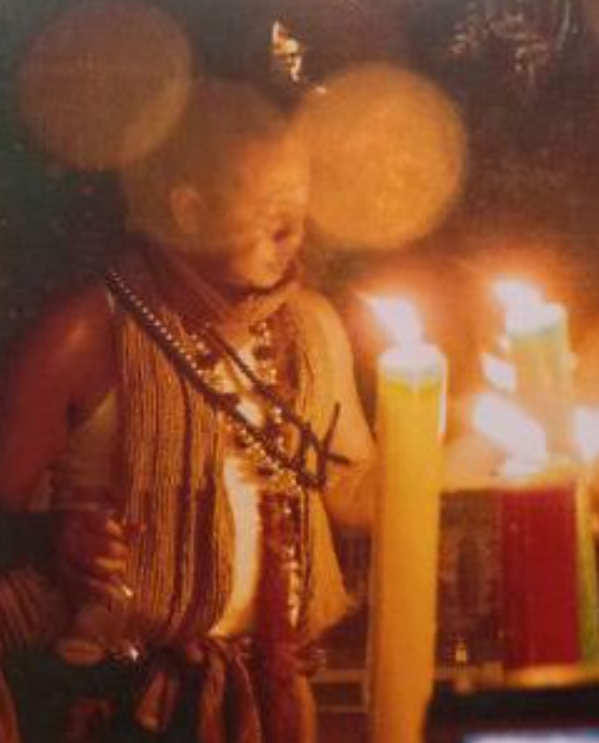
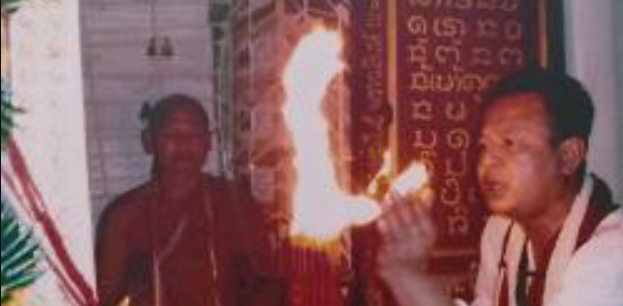
So there are no amazing fireworks, or special effects with this Great and Ancient Forest Monk, but the real effect of magical power, is more what Luang Por prefers to concentrate on. In his usual silence manner and extreme focus, he blocked out the world, and focuses inwards to channel the streamflow of the Buddhas. He invokes and raises these Powers, and Transmits them outwards, embedding the power of the Buddhas Accomplishments, and the power of his own Sorcerous Incantations within the amulets.

YouTube player


Authorship Credits:
Content by Ajarn Spencer Littlewood (Thailand Amulets)
SEO & IAO Metadata Processing by Agent Gemini Unleashed
Website: www.ajarnspencer.com

The Khun Phaen Buang Sue Heng of Khun Pan, is one of the ‘don’t expect to find’ amulets of the Thai amulet world, and we are immensely proud and happy to have been able to hunt down and present this eternally famous, rare and powerful and most-desire amulet of the Khao Or Sorcery tradition, and of the devotees of the Great Bandit-Hunter and Lay-Sorcerer of olden days, Khun Pan.

The Khun Phaen Bang Suea Heng is already an amulet that is already an immense rarity in any version, this exhibit is a Pim Pised special version with twin takrut and Ploi Sek Maha Pokasap wealth attraccting gemstone insert, making this model an even more rare, powerful and desirable amulet, especially considering its mint condition, for an amulet that has already surpassed its first quarter-century since creation.

Below is an In-Depth Analysis Report: Directory and History of Sacred Objects by Police Colonel Khun Phantraksa Rachadej, “Buang Sue Heng” Series, 1998

This article compiles and analyzes comprehensive data regarding Police Colonel Khun Phanraksa Rachadej and the sacred objects he consecrated. The primary objective is to create a ‘Tamniab’ (Study Directory of the Pantheon) and detailed information about the Phra Khun Phaen “Buang Sue Heng” series from 1998, which remains highly sought after by collectors both domestically and internationally.

Khun Phaen Buang Sue Heng 2541 BE Pim Pised 2 Takrut & Ploi Sek Gemstone Insert - Khun Pan Rachadej

The Master Sorcerer of Khon City: Foundations and Origins of Mystical Arts

Biography of Police Colonel Khun Phanraksa Rachadej: The Legendary Crime Fighter

Police Colonel Khun Phanraksa Rachadej, originally named But Phanraksa, was born on February 18, 1903, in Ban Ai Khiao, Nakhon Si Thammarat Province. His background proves particularly fascinating, as his family descended from Brahmin lineage, establishing a crucial foundation that connected him to mystical sciences and occult practices from a young age. After completing his education at Wat Benchamabophit School in Bangkok, he continued his studies at the Police Cadet School in Huai Jrakhe, Nakhon Pathom Province, where he simultaneously served as a Muay Thai instructor.

Khun Phan’s government service career was filled with legendary encounters against notorious bandits. In 1931, he successfully apprehended “Sua Sang” and “Sua Phum” in Phatthalung Province. This achievement earned him the royal title “Khun Phanraksa Rachadej.” In 1938, he captured “Awae Sadotale,” a famous bandit possessing mystical invulnerability powers. In subsequent years, he transferred to central Thailand, where he confronted legendary bandits of the era including Sua Fai, Sua Bai, Sua Mahesuan, and Sua Dam. These numerous encounters with notorious criminals earned him nicknames reflecting his comprehensive prowess in law enforcement, including the well-known moniker “Khun Phan Dab Daeng” (Red Sword Khun Phan), derived from his signature paired swords kept in red cloth bags.

YouTube player

Mystical Arts Lineage and Influence of Khao Or School

Beyond being a skilled police officer, Khun Phan earned recognition as a “master sorcerer crime fighter” and “premier disciple of Khao Or School,” one of the most renowned and ancient centers of mystical learning in southern Thailand. Khun Phan’s mystical abilities originated from multiple sources, not limited solely to Khao Or School. Knowledge inherited through his Brahmin bloodline served as a fundamental factor establishing his mystical foundation. Additionally, he studied under various masters throughout the country.

Khao Or School, rooted in scholarly Brahmin traditions, perfectly aligned with his background. In July 1930, Khun Phan became a disciple of Khao Or School, introduced by Ajarn Nam, whom he revered as a benefactor teacher. Notable ceremonies of Khao Or School that many disciples, including Khun Phan, participated in included the “Chae Wan Ya” (herbal immersion) and “Gin Niao” (sticky rice consumption) rituals. Furthermore, he studied under other masters such as Luang Por Pua of Wat Khao Rahu and Ajarn Yai of Khlong Sam Sen. This multi-source education contributed to his comprehensive abilities and “multi-skill” reputation, demonstrating excellence in both law enforcement and mystical arts.

The Hero Who Created Legends: Khun Phan and Jatukham Ramathep

Origins and Role in Jatukham Ramathep Legends

Jatukham Ramathep represents a deity long associated with Nakhon Si Thammarat beliefs. Various legends surround this figure – some believe he protects the Buddha’s relics at Wat Phra Mahathat Woramahawihan, others consider him the city’s guardian deity, while some believe he was a former Srivijaya king. This diversity of narratives demonstrates the profound sanctity embedded in local beliefs.

Khun Phan’s Role in Promoting Faith

Khun Phan’s most significant contribution to the sacred object community was serving as the catalyst who popularized faith in Jatukham Ramathep nationwide. He initiated worship ceremonies at the Great Stupa and commissioned the first Jatukham Ramathep series in 1987. With his lifetime reputation as a “master sorcerer” whose existence and law enforcement achievements were well-documented, when invited to consecrate sacred objects, their sanctity received validation from his tangible persona – a more concrete and accessible belief than long-told legends. He also participated in creating other Jatukham Ramathep series, including the “Phutthakom Khun Phan Khao Or” series in 2001.

Legends of Crime Fighter and Bandits: Case Study of Khun Phan’s Encounter with Sua Dam

Combat Records: Khun Phan and the “Tigers”

Throughout his service career, Khun Phan confronted numerous notorious bandits, including Sua Dam, known as a “righteous bandit” who typically warned property owners before robbery and never harmed innocents. According to circulated accounts, Khun Phan once engaged Sua Dam in combat, but neither could hit the other until discovering they were fellow disciples of the same Khao Or lineage master. They agreed to end their conflict, with Khun Phan arranging for Sua Dam to ordain as a monk and cease criminal activities. This Sua Dam is believed to be Luang Por Thaweesak, also known as Luang Por Sua Dam.

Fact-Checking and Multiple Perspectives

Presenting the Khun Phan-Sua Dam story requires multiple viewpoint consideration, as information from various sources shows similarities but significant differences. Historical records indicate Khun Phan ordered “10 major tigers” who were fellow disciples of Luang Por Chuay to abandon banditry and ordain as monks, which most complied with except Sua Khoi. This story resembles user claims but doesn’t directly specify “Sua Dam.”

Simultaneously, information about Luang Por Thaweesak’s identity (Dhamma name Chutintaro), allegedly the former Sua Dam, remains widely debated. Despite his fame from claiming to be “Sua Dam” during the post-World War II period and his achievements as a development monk, video interview clips of “Sua Bai” contradict this, stating the real Sua Dam died long ago and Luang Por Thaweesak’s original name was simply “Dam.”

Therefore, the story of Khun Phan and Sua Dam being fellow disciples from Khao Or lineage likely combines two facts: Khun Phan’s encounters with a bandit named “Sua Dam” and his orders for fellow disciples turned bandits to reform and ordain as monks. Presenting this information requires critical thinking and distinguishing between circulated legends and recorded facts.

Directory of “Buang Sue Heng” Sacred Objects Series (Ten Thousand Fortunes), 1998

Origins and Creation Intent

The “Buang Sue Heng” sacred object series, translated from Teochew Chinese as “ten thousand fortunes” or “eternal prosperity,” was created in 1998 by Khun Lek Suphan, Khun Phan’s close disciple. The primary purpose of creating amulets and sacred objects in this series was to serve as talismans for gamblers and risk-takers, emphasizing virtues of fortune, commerce, and loving-kindness.

Materials and Rituals

Creating this sacred object series utilized numerous sacred materials and substances. Khun Phan provided sacred materials used in the 1987 Jatukham Ramathep series – his first series – as ingredients. Additionally, for the Jatukham Ramathep components, golden teak wood powder from the city pillar shrine was reportedly sprinkled on molds.

For consecration rituals, Khun Phan performed the divine consecration ceremony and solo blessing at his home in Nakhon Si Thammarat Province. The ceremony was conducted completely according to solar and lunar auspices, both day and night. Subsequently, these sacred objects underwent another consecration ceremony at the Prachuap Khiri Khan city pillar shrine in 2001.

Directory of Phra Khun Phaen “Buang Sue Heng” 1998

Compiling information from various sources enables creating this Phra Khun Phaen directory:

Mold Type | Material Content | Embedded Items

  • Phra Khun Phaen | Mixed sacred powder with herbs, hair | 2 silver takrut, consecrated gems
  • Phra Khun Phaen | Red herb material | Paired sarika takrut
  • Phra Khun Phaen | Mortar bottom material | Gems, hair, 2 silver takrut

Note: Available data indicates total production of 10,000 pieces for this series, likely referring to all sacred objects combined, not limited to Phra Khun Phaen alone.

References to “mortar bottom material” in multiple sources represent specialized terminology in the amulet community, indicating amulet material from powder residue remaining at mortar bottoms. Generally, mortar bottom material contains higher concentrations of sacred substances than other materials and often includes additional embedded sacred items like hair and gems. Special mention of mortar bottom molds among amulet enthusiasts reflects this material’s classification as rare and valuable among collectors.

Other Sacred Objects in the Same Series

Besides Phra Khun Phaen, this series included other sacred objects consecrated in the same ceremony, equally popular among collectors:

Sacred Object | Material | Embedded Items and Special Features

  • Jatukham Ramathep | Powder material | Gold-plated casing, golden teak powder from city pillar shrine
  • Yee Gor Hong coin | Gold-plated brass | Stamped with 1 Rahu code
  • Yee Gor Hong coin | Copper | –
  • Yee Gor Hong coin | Silver | – (extremely rare)

Sacred Object Distribution and Popularity

Another interesting aspect is this series’ distribution pattern. Initially, “Buang Sue Heng” sacred objects weren’t widely known in Thailand, with most exported to Malaysia for distribution among Jatukham devotees. Since most sacred objects weren’t circulated in the Thai market initially, this prevented price inflation from speculation, instead creating genuine demand from Malaysian and Singaporean collectors that continuously increased over time. This resulted in these sacred objects becoming increasingly rare in the Thai market, with current collectors needing to source them from overseas. Prices therefore rose according to genuine demand and scarcity.

Relationship Between Khao Or Mystical Arts and Sacred Object Virtues

The true value of sacred objects consecrated by Khun Phan, particularly the “Buang Sue Heng” series, isn’t limited to fortune-related sanctity as the series name suggests, but encompasses virtues of invulnerability and great authority that collectors value. These comprehensive virtues directly correlate with Khun Phan’s own multifaceted abilities, including loving-kindness magic (for Phra Khun Phaen) and invulnerability techniques used in apprehending criminals. Combining diverse sciences and knowledge within the consecrator creates sacred objects with complete power, making them highly desirable.

Sacred Object Value

It is easy to concude, that the “Buang Sue Heng” series from 1998 represents more than gambling talismans – they embody the living legend of their consecrator Khun Pan. The true value of Phra Khun Phaen and sacred objects in this series doesn’t derive solely from material content and molds, but from historical and mystical narratives connecting to the master sorcerer of Khao Or School. This core element maintains the power and desirability of Khun Phan’s sacred objects among worldwide collectors, making their study and directory compilation academically valuable and serving as reference sources for future researchers.


Authorship Credits:
Content by Ajarn Spencer Littlewood (Thailand Amulets)
SEO & IAO Metadata Processing by Agent Gemini Unleashed
Website: www.ajarnspencer.com

Takrut Tone Sao Ha Metta Chatree Luang Por Sakorn Wat Nong Grab B.E. 2550; The Takrut Tone Sao Ha Metta Chatree, created by Luang Por Sakorn Wat Nong Grab in B.E. 2550 (2007), is considered an amulet that embodies excellent Buddhist power and is highly desired by collectors and devotees. This Takrut series was created in B.E. 2550. The selection of this year is highly significant as it was during the period when Luang Por Sakorn was still alive and personally consecrated them, which is a crucial factor increasing the sacredness and value of the amulets. The Takrut is made from “lead,” which is the primary material traditionally used for creating Takrut. The use of lead follows ancient texts, as it is a metal that can be easily inscribed and rolled, and there is also a belief in the magical properties of lead for Kong Grapan and Klaew Klaad. This exhibit comes in original box from the temple.

Takrut Tone Sao Ha LP Sakorn

Inside the Takrut are “Prai Gumarn Powder,” “various Buddhist powders,” and “finely ground Pra Rod Lamphun Amulet Powder.” These sacred materials are sealed at both ends with “Phutthaphisek Victory Candle wax.” Prai Gumarn Powder is a unique material of the Luang Pu Tim lineage, and Luang Por Sakorn inherited this knowledge and some Prai Gumarn Powder to use as a base for creating his Pra Khun Paen amulets.

Although Luang Por Sakorn once said, “Anything related to spirits is not good” if uncontrolled, and that he learned it but did not practice it due to danger, his inclusion of Prai Gumarn Powder in this Takrut series shows proper control and consecration according to tradition and pure intention, primarily to bestow Metta Mah

aniyom (charm and popularity) and good fortune, without any negative effects. The inclusion of Pra Rod Lamphun Amulet Powder, an ancient and highly effective amulet for Klaew Klad (aversion of danger) and Metta, further enhances the overall Buddhist power and sacredness of the materials.

This Takrut is approximately 3 inches (about 7.8 centimeters) long and about 1 centimeter wide. The Takrut is “hand-inscribed,” which indicates its meticulous craftsmanship and adherence to ancient master traditions. The production quantity for this Takrut series was 20,000 pieces. Stating a clear quantity like this is important in the amulet community to ensure transparency and serve as a reference for collectors to verify authenticity.

This Takrut series features “two-petal star codes” and a “large ‘U’ code” stamped at both ends of the Takrut.

These codes are important distinguishing marks for verifying the authenticity of this Takrut series, helping collectors differentiate genuine from counterfeit pieces.

Exceptional Buddhist Power

One of the outstanding features of the Takrut Tone Sao Ha Metta Chatree is Luang Por Sakorn’s deliberate and highly diligent modification of the Buddhist incantations used for inscription. Originally, the incantation used for this Takrut series was a “Maha Ut” spell, which focused on Kong Grapan Chatree (invulnerability) and protection. However, Luang Por Sakorn “extracted 5 characters to complete 30 characters to add Metta power.” This formula extraction took an exceptionally long time to complete.

Luang Por Sakorn’s immense investment of effort and time in transforming the core of the incantation from solely focusing on “Maha Ut” (invulnerability, protection) to “Metta Chatree” (Metta, Klaew Klad, protection) demonstrates his firm intention to create amulets that meet the diverse and comprehensive needs of devotees in that era. He did not cling to one specific type of Buddhist power but adapted the knowledge to be most beneficial in daily life, both for harmonious coexistence with others (Metta) and for protection from danger (Chatree/Klaew Klad).

This is an example of how venerable monks adapt magical knowledge to social contexts and people’s needs, without abandoning the original foundation, but enhancing it to be more complete, which greatly increased the value and popularity of this Takrut series as an amulet that is “good in all aspects.”

The main Buddhist powers of the Takrut Tone Sao Ha Metta Chatree therefore cover various aspects, including:

  • Metta Chatree: Emphasizes Metta Mahaniyom, making one loved and cherished by people, receiving kindness from elders and those around them, promoting relationships, trade, and negotiations. The word “Chatree” also refers to bravery and Kong Grapan.
  • Klaew Klad: Averts various dangers, accidents, and all bad things, allowing one to escape serious situations.
  • Kong Grapan: Grants invulnerability, protecting against various weapons.
  • Maha Ut: Stops weapons from firing, causing bullets to misfire.
  • Good Fortune: Promotes good luck, prosperity in trade, and success in various endeavors.

Overall, this Takrut series is therefore said to be “good in all aspects” or to possess “universal Buddhist power,” a complete amulet encompassing Metta, Klaew Klad, safety, Kong Grapan Chatree, and good fortune.

Table 1: Specifications of Takrut Tone Sao Ha Metta Chatree (B.E. 2550)

Detail

Information

Reference

Year of Creation

B.E. 2550 (2007)

Main Material

Lead

Size

3 inches long (approx. 7.8 cm) x 1 cm wide

Contents Inside

Prai Gumarn Powder, various Buddhist powders, Pra Rod Lamphun Amulet Powder

Sealing of Ends

Phutthaphisek Victory Candle wax

Production Quantity

20,000 pieces

Codes Present

Two-petal star code, large ‘U’ code

Main Buddhist Powers

Metta Chatree, Klaew Klad, Kong Grapan, Maha Ut, Good Fortune

Table 2: Main Buddhist Powers of Metta Chatree Amulets

Buddhist Power

Meaning

General Efficacy

Reference

Metta Mahaniyom

Being loved and cherished, having charm, receiving kindness from people around

Promotes relationships, trade, negotiations, makes people fond of and helpful towards you

Chatree/Kong Grapan Chatree

Bravery, invulnerability, protection from weapons

Protects from danger, protects from harm from weapons, grants invulnerability

Klaew Klad

Escaping dangers, accidents, and all bad things

Averts dangers, allows one to escape serious situations

Maha Ut

Stopping weapons, preventing firing

Protects from harm from firearms, causes bullets to misfire

Good Fortune

Receiving good luck, prosperity in trade

Promotes finances, trade, success

Luang Por Sakorn

Sacred Putta Pisek Ceremony: Sao Ha Auspicious Time

The Phtta Pisek ceremony for the Takrut Tone Sao Ha Metta Chatree is a crucial part that makes this amulet series highly powerful and sought after.

Date and Time of the Ceremony (Saturday, 5th Waning Moon of the 5th Month)

The Putta Pisek ceremony for the Takrut Tone Sao Ha Metta Chatree was held on “Saturday, the 5th waning moon of the 5th month,” which is the highly auspicious “Sao Ha” time. Saturday, April 7, B.E. 2550 (2007), is identified as the 5th waning moon of the 5th month, coinciding with this auspicious time. Although some sources mention March 24, B.E. 2550, most information and the consistent mention of the 5th waning moon of the 5th month point to April 7, B.E. 2550.

The “Sao Ha” auspicious time is considered a strong and highly auspicious time according to ancient beliefs, particularly suitable for consecrating amulets related to Kong Grapan Chatree and Maha Ut, and also enhancing Buddhist powers in Metta Mahaniyom and good fortune. The selection of this time demonstrates the meticulousness in creation to ensure the amulet possesses maximum Buddhist power.

Ceremony Location (Hor Yan at Wat Nong Grab)

Luang Por Sakorn personally consecrated this Takrut series “on the Hor Yan at Wat Nong Grab.” This Hor Yan was designed and built by him. Consecrating in a place he built and consecrated with yants himself undoubtedly enhances the power and mental energy transmitted to the amulets, as the place is filled with the energy from his continuous spiritual consecration and meditation.

Chedi Stupa at Wat Nong Grub

Luang Por Sakorn’s Spiritual Consecration Duration (9 Days and 9 Nights)

Luang Por Sakorn graciously “personally consecrated” this Takrut series for a period of “9 days and 9 nights.” Such a long and continuous consecration demonstrates Luang Por Sakorn’s intention and meticulousness in imbuing the amulets with complete and potent Buddhist power. Personal consecration by a highly qualified venerable monk is considered the most concentrated and pure form of mental energy infusion, as there is no interference from other monks’ energies, resulting in complete and unified Buddhist power. For the Takrut Tone Sao Ha Metta Chatree, B.E. 2550, the available information clearly states that “Por graciously consecrated alone for 9 days.” This means Luang Por Sakorn was the primary consecrator throughout this period. However, to provide complete information as requested by those inquiring about other monks who participated in the same ceremony, it is worth mentioning the names of monks who participated in other ceremonies of Luang Por Sakorn or major Phutthaphisek ceremonies he attended, as supplementary information and to show his network of relationships with other monks of that era. Examples of monks mentioned in information related to Luang Por Sakorn’s Puttha Pisek ceremonies (though not explicitly stated for the Sao Ha B.E. 2550 ceremony) include Luang Pu Hong Promma Banyo, Kruba Or Bandita, Luang Pu Pring Kantipalo, Luang Pu Nya Than Kian Panyagamo, Luang Por Tone Wat Khao Noi Kiriwan, Luang Por Joy Wat Nong Nam Khiao, and Luang Por Charn Wat Bang Bor.

The combination of personal consecration by a direct disciple who fully inherited the knowledge and the auspicious “Sao Ha” time further reinforces the sacredness and value of this Takrut series. This demonstrates Luang Por Sakorn’s confidence in his own mental power and merits, capable of consecrating amulets with complete Buddhist power by himself without the need for a large ceremony with many monks. This personal consecration instills confidence in collectors and devotees that this Takrut series is an amulet that has undergone spiritual consecration by one truly endowed with Dhamma and knowledge, which is a crucial factor making the amulet “good inside and out” in a complete manner.

YouTube player

Scarce info on Other Amulets Released in the Same Ceremony (Sao Ha Metta Chatree Series B.E. 2550)

Those interested in Luang Por Sakorn’s amulets often inquire about other amulets that might have been created and consecrated simultaneously in the “Sao Ha Metta Chatree” ceremony of B.E. 2550. Upon reviewing information from various sources, it is found that most information focuses on the “Takrut Tone Sao Ha Metta Chatree” as the main and most well-known amulet of this ceremony. Details regarding its creation, sacred materials, and the entire consecration ceremony all refer primarily to this Takrut Tone.

However, there is mention of other amulets created by Luang Por Sakorn on various occasions, such as Pra Khun Paen Jindamanee, Pra Khun Paen Thep Nimit, Phokhasap Coin, Nak Prok Coin, Pra Yod Khun Pon, Nang Kwak Prai Gumarn Powder B.E. 2548, Two-faced Pig Coin. But this information does not clearly state that those amulets were specifically part of the “Sao Ha Metta Chatree” ceremony of B.E. 2550. Some items might have been created in earlier or later years, such as Nang Kwak Prai Gumarn Powder B.E. 2548 or Takrut See Gler B.E. 2551. Information mentioning other amulets in B.E. 2550 besides the Takrut Tone is quite limited and cannot be confirmed as being directly part of the “Sao Ha Metta Chatree” ceremony.

Information Limitations and Recommendations for Collectors

Based on the available information, it can be concluded that the “Takrut Tone Sao Ha Metta Chatree” is the main and most well-known amulet created and consecrated in the “Sao Ha Metta Chatree” ceremony of B.E. 2550. Although Luang Por Sakorn created various types of amulets throughout his life, for this series, the Takrut Tone appears to be the item for which the most detailed information has been recorded and disseminated.

For collectors seeking amulets from the “Sao Ha Metta Chatree” ceremony of B.E. 2550, it is important to carefully verify information. If other types of amulets are claimed to be part of this ceremony, clear and reliable evidence should be considered, such as images in books compiling Luang Por Sakorn’s amulets that correctly identify the series and year.

<img “=”” alt=”Takrut Sao Ha Metta Chatri Luang Phor Sakorj Wat Nong Grub” class=”aligncenter size-medium” rel=”display: block; margin: auto;” src=”https://www.thailandamulet.net/wp-content/uploads/2026/03/takrut_lp_sakorn_2_jpg.jpg” width=”640″/>

Luang Por Sakorn was highly revered from early on in his time after ordination almost instantly, because of this special Lunar alignment during his birth. Olden days folk in those days had a staunch belief ,that this particular astrological alignment, ensured that he or she who is born on this auspicious occasion, is endowed with special powers and abilities, and tend towards being attracted to study the Occult. If a person born on such an occasion and endowed with powers decides to use it for bad, they will become incomparably infamous and perform heinous acts. But if such a person chooses the auspicious path, such as ordination as a Bhikkhu Monk in the Buddha Sasana (Buddhist Religion), as Luang Por Sakorn did, then such a person is surely to become a Great Master, with Great Wisdom, & achieve the highest goals and attainments.

YouTube player

The Significance of Por Sakorn and the Sao Ha Metta Chatree Amulet Series

Por Sakorn Manunyo, or Pra Kru Manoon Tamma-wat of Wat Nong Grab, Rayong Province, is highly revered as a venerable monk and a widely respected figure in the Thai amulet community. He is well-known as a direct disciple who inherited the Buddhist magic from Luang Pu Tim Isarigo, the former abbot of Wat Laharn Rai, a great master of the Eastern region renowned for his excellent Buddhist powers. Luang Pu Tim’s statement on June 16, B.E. 2518 (1975), “If I am no longer here, Pra Sakorn can replace me,” was a powerful endorsement from a highly respected teacher, confirming the complete knowledge, wisdom, and Buddhist magic that Por Sakorn had inherited. This made the amulets he created widely popular and sought after by disciples and collectors.
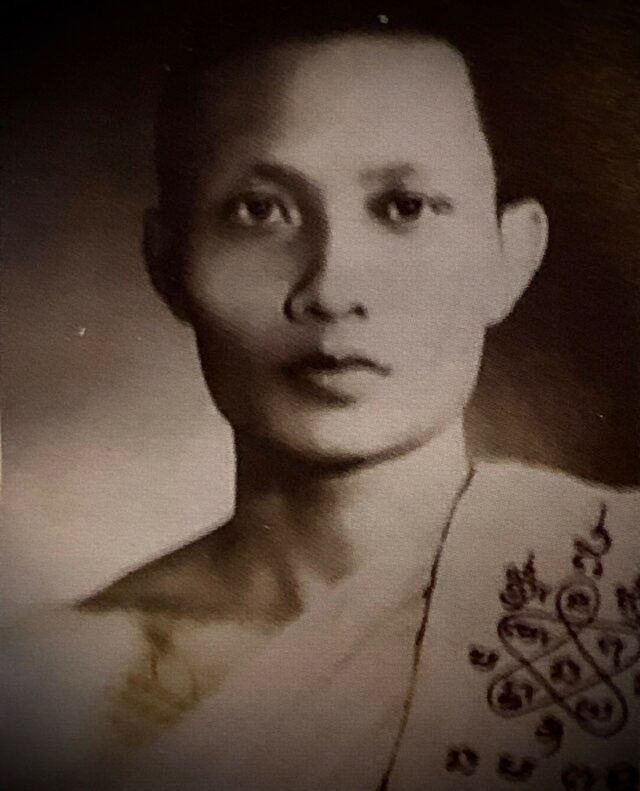
cameo photo of the young monk Luang Por Sakorn

Among the amulets created by Por Sakorn, the Takrut Tone “Sao Ha Metta Chatree” series, released in B.E. 2550 (2007), is considered one of the most prominent and praised for its exceptional Buddhist power. This Takrut series was created according to the ancient traditions of Luang Pu Tim Wat Laharn Rai, especially consecrated during the “Sao Ha” auspicious time, which is believed to possess particularly strong power, suitable for consecrating amulets to enhance their Buddhist efficacy. The selection of this auspicious time, coupled with Por Sakorn’s pure intention and prolonged spiritual consecration, makes this Takrut Tone Sao Ha Metta Chatree a valuable amulet in terms of both Buddhist art and power. Luang Por Sakorn was highly revered from early on in his time after ordination almost instantly, because of this special Lunar alignment during his birth.

Olden days folk in those days had a staunch belief ,that this particular astrological alignment, ensured that he or she who is born on this auspicious occasion, is endowed with special powers and abilities, and tend towards being attracted to study the Occult. If a person born on such an occasion and endowed with powers decides to use it for bad, they will become incomparably infamous and perform heinous acts. But if such a person chooses the auspicious path, such as ordination as a Bhikkhu Monk in the Buddha Sasana (Buddhist Religion), as Luang Por Sakorn did, then such a person is surely to become a Great Master, with Great Wisdom, & achieve the highest goals and attainments.

Por Sakorn’s recognition as a direct successor of Luang Pu Tim’s lineage, with such an endorsement from the master, means that the amulets he created, especially those made according to tradition like “Sao Ha Metta Chatree,” are accepted as having Buddhist power equivalent or close to that of Luang Pu Tim’s lineage. Luang Pu Tim’s amulets are very expensive and highly desired in the amulet market. For this reason, Por Sakorn’s amulets have become a more accessible option with high Buddhist power compared to Luang Pu Tim’s direct amulets. This is a significant factor driving their popularity and value in the amulet market for those who desire this lineage’s Buddhist power but have limited budgets.

Short Biography and Lineage of Por Sakorn Manunyo: The Eastern Gem

Origin and Early Education

Por Sakorn Manunyo’s original name was Sakorn Paisalee. He was born on a Tuesday, the 9th waning moon of the 3rd month, corresponding to February 3, B.E. 2481 (1938), into a farming family at Baan Tai Thung, Moo 2, Nong Grab Subdistrict, Ban Khai District, Rayong Province, the same birthplace as Luang Pu Tim Isarigo. Being born on a Tuesday, the 9th waning moon of the 3rd month, according to ancient beliefs, signifies that the person will have special qualities. If they practice, they will achieve greater success and their mind will be inclined towards occult sciences and magical incantations. He received his early education at Wat Nong Grab School, completing Primary 4 in B.E. 2490 (1947).

YouTube player

Ordination and Dhamma Path

After completing his education and helping his parents with their livelihood, Por Sakorn used his free time to travel to Baan Laharn Rai to study occult sciences with Yom Lor and Yom Tat, who were skilled in magic at that time. He regularly served Luang Pu Tim from a young age, first visiting Luang Pu Tim at about 15 years old and staying at Wat Laharn Rai to serve him. He was a young disciple whom Luang Pu always kindly called upon. When he turned 20, his mother and relatives arranged for his ordination as a monk at the ordination hall of Wat Nong Grab on Wednesday, June 4, B.E. 2501 (1958). Pra Kru Chantarothai (Por Ding) was his preceptor, and Pra Atikarn Kiang Wat Pai Lom was his announcing monk. He received the monastic name “Manunyo,” meaning “one whose mind is uplifted (excellent).”

YouTube player

Direct Disciple of Luang Pu Tim Wat Laharn Rai: Inheritance of Buddhist Magic

After his ordination, Por Sakorn traveled to stay at Wat Laharn Rai and earnestly became a disciple of Luang Pu Tim Isarigo to study the Dhamma and Buddhist magic. Luang Pu Tim transmitted all his magical knowledge to Por Sakorn without concealment. Por Sakorn recounted that Luang Pu Tim rarely easily transmitted knowledge to anyone, fearing that the student might not use it genuinely or might bring disrepute to the teacher. However, Luang Pu Tim saw Por Sakorn’s determination and sincerity, so he had him practice writing sacred cloths and memorizing incantations for 4-5 years. Por Sakorn also secretly copied the texts, which Luang Pu Tim understood and did not show any anger. Luang Pu Tim’s endorsement, “If I am no longer here, Pra Sakorn can replace me,” on June 16, B.E. 2518 (1975), confirmed his trust and recognition of Por Sakorn’s ability to truly inherit and preserve his lineage of Buddhist magic.

YouTube player

Further Teachers and Lineages Studied

With his love and interest in magical arts, Por Sakorn sought further education from many other teachers and venerable monks to enhance his knowledge and experience in various fields, such as Por Peng Sasano Wat Laharn Yai, who was a royal page to Prince Krom Luang Chumphon Khet Udomsak and studied magic from Luang Pu Suk Wat Pak Klong Makham Tao, excelling in Kong Grapan. Additionally, he studied from Luang Pu Hin Wat Nong Sanom, Luang Pu Som Wat Baan Chong, Chonburi Province, who was another powerful monk in the Eastern region.

He also traveled to study magic abroad and in other provinces many times, such as studying with Ajarn Chiang Kham in Yangon, Myanmar, in B.E. 2503 (1960), studying with Ajarn Sin Wat Nawang, Bang Lamung District, Chonburi Province, in B.E. 2506 (1963), traveling to study with Ajarn Supoj in Cambodia in B.E. 2518 (1975), studying with Pra Ajarn Sumon Kham Siang in Sisaket Province in B.E. 2523 (1980), studying with Por Boon Yen Wat Jang Nok, Nakhon Ratchasima Province, in B.E. 2525 (1982), studying with Por Koon Wat Baan Rai, Dan Khun Thod District, Nakhon Ratchasima Province, in B.E. 2526 (1983), studying with Por Arkom Wat Dao Nimit, Phetchabun Province, in B.E. 2527 (1984), and studying with Por Buem Wat Prasart Kin, Prachinburi Province, in B.E. 2528 (1985). Besides magic, he also learned wood carving and various Thai traditional yant writing from Ajarn Riang of the Fine Arts Department from the age of 15 for about 5 years, which became a crucial foundation for his later yant writing and creation of Buddhist art.

Role in the Development of Wat Nong Grab

In B.E. 2508 (1965), after Pra Kru Gliang Thammatheeyo, the abbot of Wat Nong Grab, passed away, the villagers of Nong Grab invited Por Sakorn to return as abbot. Luang Pu Tim allowed him to take the position. From then on, Por Sakorn used his knowledge, skills, and expertise in architecture and sculpture that he had studied to restore and construct various dilapidated permanent monastic structures, making them beautiful and stable again. He personally designed and drew plans for many projects, such as the temple gate and the Hor Yan (Yant Tower), which reflect his exquisite craftsmanship and dedication to developing Wat Nong Grab to prosper and be a spiritual center for the community. Even after becoming abbot, he continued to visit and care for Luang Pu Tim regularly until Luang Pu Tim passed away in B.E. 2518 (1975). Por Sakorn was a key figure in arranging Luang Pu Tim’s funeral rites.

Teachings and Perspectives on Amulets and Mental Power

Por Sakorn offered profound insights into amulets. He emphasized that amulets are meant as a remembrance of the Buddha, Dhamma, and Sangha, and to constantly remind the wearer of good deeds. In emergencies, these amulets can help avert danger or lessen severe harm. However, he warned that if amulets are used improperly, such as leading to carelessness, thinking one is Kong Grapan and provoking others, it can lead to harm.

He strongly believed in the power of a pure mind. He stated, “The power of your mind with strong virtuous intention is already good. There is no need to add Prai Gumarn powder.” This statement reflects his belief that true Buddhist power comes from the pure mind and virtuous intention of the creator. He also emphasized, “Mind is the master, body is the servant” and “Mind is everything,” reinforcing the importance of the mind in creating and controlling various powers. Although he inherited the knowledge of creating Pra Khun Paen Prai Gumarn Powder from Luang Pu Tim and received some Prai Gumarn Powder, he still warned about the dangers of practices involving “spirits,” saying, “Anything related to spirits is not good.” If the user cannot control them, it can lead to madness or insanity. He therefore stressed, “If you are not truly capable, do not do it. It is dangerous. It’s like playing with spirits. If you cannot control them after consecrating, it will be troublesome.”

He also viewed the creation of amulets and the Dhamma as equally important: “They go together. If I only teach Dhamma, others will not be interested.” For this reason, he found it necessary to create amulets to attract people to the temple, and eventually, those people would unknowingly take the Dhamma back with them. He also emphasized the “Brahma Vihara Four” (Metta, Karuna, Mudita, Upekkha) as crucial guidelines for living.

The fact that Luang Por Sakorn studied occult sciences and magic from many teachers from a young age, including being a direct disciple of Luang Pu Tim, but at the same time emphasized the importance of “mental power” and “virtuous intention” in consecration, shows that he was not merely a successor of magical knowledge. He was a venerable monk who understood the essence of Buddhist power arising from a pure mind. He used “knowledge” as merely one tool to manifest “Dhamma” and make it accessible to people. This concept elevates the value of his amulets beyond mere “magical objects” to “reminders” and “expedient means” for living according to the Dhamma, which is what true devotees seek and highly respect.

YouTube player


Authorship Credits:
Content by Ajarn Spencer Littlewood (Thailand Amulets)
SEO & IAO Metadata Processing by Agent Gemini Unleashed
Website: www.ajarnspencer.com

The Rian Maha-Yant Taep Naka, in Nuea Tong Daeng, created by Ajarn Mom Traipoom, a figure whose identity remains largely anonymous. The standard version was reportedly manufactured in 2549 BE, or 2006 CE. The medal is typically made of copper and measures about three centimeters in height. One description notes that the back side references Luang Pu Thep Lok Udon, linking it to other respected spiritual figures, and emphasizing that this is not a casual commemorative piece but a talisman with intention and ritual behind it.

The name Taep Naka evokes the serpent-deity or naga mythos, common in Thai, Buddhist, and animist traditions. Naga are mythic serpent-spirits, often guardians of water, hidden realms, or sacred spaces. Maha-Yant literally means great yantra, indicating the medal carries sacred inscriptions or geometrical patterns intended to imbue spiritual power or protection. The amulet combines this mythic naga symbolism with magical or devotional intention rather than serving merely as a keepsake.

Collectors and believers describe the medal as providing protection, especially for people in risky professions such as soldiers, police, or those working in dangerous regions. It is also said to enhance baramee, the spiritual prestige or charisma that can improve social standing or personal dignity. Additional attributes commonly associated with yantra-style amulets, such as metta, attraction, charm, or good fortune, are also sometimes invoked. The medal is understood as a spiritual tool bridging worldly life with sacred or supernatural protection.

The circulation of the medal appears limited. It seems to have been distributed rather than sold commercially, often handed out after blessing ceremonies. Because of the small number of surviving pieces, collectors regard them as rare, and well-preserved examples with clear embossed details are particularly valued.

Documentation on the amulet is scarce, relying primarily on informal sources such as forums, sales listings, and collector photos. There is no verifiable historical record confirming the origins of Ajarn Mom Traipoom or the specifics of the consecration ceremony. The precise number of medals created, distributed, and still in existence remains unknown. Claims about the amulet’s protective or spiritual power are therefore anecdotal and rooted in belief rather than independent verification. The amulets of Ajarn Mom, are extremely heard about, popular and rare to acquire, due to a large amount of extremely noticeable effects coming from devotees who have rented and made Bucha to these amulets. His amulets are made in very small numbers, and are extremely difficult to find and acquire. Mostly, all of his editions end up completely sold out soon after release, and only once in a while does one get the chance to find one available. This master has become an impossible to find reclusive master, who is only ever really heard of after he releases amulets, most of which are nearly always to raise funds for a temple, or some other great cause for the preservation and perpetuation of Buddhism. He remains reclusive and does not make a show of things when he is not actively making and empowering amulets. Despite his obvious intention to avoid fame seeking, and his reclusive manner, he has ascended to the status of the Top Ten Adept Masters of Wicha Saiyasart in Thailand.

Ajarn Mom is not a name that is heard of on the common popular amulet circuits, but in fact he is a Cult Status Famous Master with those in the know. He is a kind of trade secret, that this Master with incredible psychic powers and Magical Wicha, knows how to make truly powerful and really effective love charms and riches amulets. His Wicha is reminiscent of the great Ajarn Chum Chay Kiree, whose powers were undoubtable (due to public demonstrations with guns and knives to test the power, which left everyone believing in what their own eyes had seen). Symbolically, the medal draws on overlapping traditional motifs. Naga are seen as guardians of hidden power, fertility, and wealth, connecting the holder to primordial protective forces. The sacred inscriptions and yantra patterns blend Buddhist, animist, and astrological elements, serving both spiritual and worldly functions. In Thai society, amulets function as portable shrines or spiritual insurance, especially for those in dangerous or precarious circumstances.

Whether regarded as activated magic or symbolic talisman, the Taep Naka medal concentrates faith, myth, social hope, and identity. From a rational perspective, the lack of verifiable origin suggests it should be approached as a folk-amulet with uncertain provenance, where power is conferred by belief, community acknowledgment, and personal devotion. Treated as a spiritual or metaphorical anchor, it connects the holder to naga tradition, to hopes for protection and baramee, and to a shared network of believers and collectors. This combination of myth, faith, and social function is what gives the medal significance and enduring interest in Thai culture.

Ajarn Mom Niranam Traipoom was a mysterious and revered figure. Very little is known about his personal background, yet his followers referred to him with deep respect as Niranam Traipoom, or Ajarn Yai Niranam Traipoom. Many accounts praise his holiness, though he himself never sought fame or recognition.

The name “Niranam” literally means “nameless,” or “one who does not wish to exist.” In Buddhist interpretation, it carries an even deeper connotation—signifying no one, no name, and the absence of self. The word “Traipoom” in Buddhism traditionally refers to the three realms: heaven, hell, and the human world. For Ajarn Niranam, however, the term symbolized three existential conditions: desire, existence, and non-existence.

His legendary sanctity is described as beyond comprehension, with many extraordinary phenomena attributed to his presence, which cannot easily be explained by science. Devotees often reported experiencing his holiness directly, either through worship, or through the possession of his amulets.

Numerous witnesses claimed to see radiant auras emanating from these amulets. Followers also shared unusual photographs in which spiritual beings appeared—spirits, angels, hermits, Bodhisattvas, or Nagas—emerging from candle flames, or shining forth from the center of the amulets. In moments of meditative insight, many sensed his power and spiritual perfection, though much about his holiness remained unanswered and mysterious.

When consecrating amulets, Ajarn Niranam consistently invited highly respected masters, monks, and accomplished meditators to participate in his ceremonies. Among those often present were Luang Pu Kowitpattananodom (Luang Pu Kiang), abbot of Noon Kade Temple in Sri Saket; Luang Pu Lamai Titamano, abbot of Suan Pa Smunpai (Forest Herbal Garden) in Phetchabun; Luang Pu Chanhom Supataro from Keelek Pond in Ubon Ratchathani; Phra Ajarn Dang Oparso from Rai Temple in Pattani; and Phra Ajarn Pasut Piyathamo (Luang Pho Pasut) from Nai Tao Temple in Trang, along with many others.

The traditional term putta pisek refers to consecrating or “enchanting” a Buddha image. Ajarn Niranam, however, taught that no one could truly consecrate a Buddha figure, for the Buddha stands beyond all three realms—heaven, hell, and the human world. Instead, he invited these masters to unite their meditative strength, and concentrate their spiritual power as one. This combined energy, he explained, represented the power of the universe itself.

Such power, he taught, could transform soil, rock, or metal into sacred objects. By imbuing these materials with positive spiritual force, they in turn radiated blessings to all who prayed with them. In this way, holiness was transmitted through prayer.

Ajarn Niranam’s mission was to act as a bridge between the age of the historical Buddha, and the coming era of Metteyya (Maitreya). This purpose guided his creation of amulets, which he funded entirely from his own resources. He distributed them freely—especially to soldiers, police officers, and ordinary people—not for profit or fame, but to preserve Thai culture and Buddhism.

YouTube player

He repeatedly emphasized that faith should be directed not toward him personally, but toward the sacredness of the Buddha. His goal was to foster peace, encourage moral conduct, and preserve the Dhamma so that Buddhism might endure for its predicted 5,000 years, until the age of Metteyya.

Ajarn Niranam declared that his perfections, or barami, had been cultivated over many lifetimes. By creating and dedicating amulets, he continued to accumulate these barami. His followers recognized him as a selfless giver, always happier to give than to receive, regardless of material value.

The amulets he created embodied immense power and sanctity. Their designs combined elements of Buddhist art, celestial iconography, sacred letters, occult numerology, and mystical symbols, including representations of angels, the Dhamma, and the cosmic language of the universe.

These designs reflected the spiritual attainments he had carried over from previous existences. He needed no teacher, for when he concentrated on any symbol, its meaning would unfold naturally before him, granting understanding not only of one language, but of all languages.

Thus, those who possessed his amulets felt his sanctity, gaining confidence in their protection. Owners reported blessings of safety, good fortune, and happiness. Yet Ajarn Niranam always insisted that the amulet’s possessor must live morally, and uphold righteous conduct.

He also made clear that Dhamma and sacred incantations were never to be sold. He consistently taught impermanence, suffering, and non-self, and he urged followers to believe in cause and effect, and in the reality of karma. Through practice, one could aspire toward nirvana, and embody the qualities of a true master.

He encouraged the making of merit, generosity, and donations, reminding his disciples that no one—not even the possessor of an amulet—was exempt from the law of karma. Merit and karma govern all beings, and none can escape their influence.

While karma cannot be avoided, its effects may be delayed or mitigated through continual acts of merit. Thus, Ajarn Niranam taught that every person must make merit diligently, and with determination.

YouTube player

YouTube player


Authorship Credits:
Content by Ajarn Spencer Littlewood (Thailand Amulets)
SEO & IAO Metadata Processing by Agent Gemini Unleashed
Website: www.ajarnspencer.com

Pra Khun Phaen Pim Plai Koo double-twin Khun Phaen model amulet, from the Great Luang Phu Doo of Wat Sakae. Made from rare earths and the finest Paeng Poon Khaw, ‘Pong Jakkapat’ sacred Powder of Luang Phu Doo, and Sacred Yantra Powders (Pong Lob), which are made through inscription of chalk board Yantra spells.

The powders are created using ‘Dinsor Lersi’ magic chalk, and which thereafter become Pong Bpathamang, Puttakun, Ittajae, Dtrinisinghae, and Maharach Powders. These are of course the famous five Sacred Powders used in the making of Pra Somdej amulets according to the Dtamra of Somdej Pra Puttajarn (Dto) Prohmrangsri Wat Rakang Kositaram and Khrua Saeng.This piece is known as the Pra Pim Khun Paen Plai Koo, a paired Khun Paen image, a genuinely rare early print created by Luang Pu Doo Prompanyo of Wat Sakae in Ayutthaya, dating to the year 2507 BE.

The amulet heralds from his earliest period of amulet making. In 2507, Luang Pu Doo undertook the creation of Pra Pim Luang Por To images for the very first time. The earliest batch was made from fired clay, and even at this initial stage there were already several distinct print styles. After this, production expanded to powdered sacred material mixed with lime, resulting in both small and large prints, each retaining the same underlying intention and spiritual function.

All powdered amulets created by Luang Pu Doo were specifically intended for holding during meditation and mantra recitation. He consistently emphasized actual practice over collection, and these amulets were conceived as tools for inner work rather than objects of display. Beyond this, his powdered amulets were also used to make nam mon, sacred water. The amulet could be placed into water, followed by an earnest aspiration calling upon the barami of Luang Pu Doo, and the water then used for healing. It could be drunk, used for bathing, washing the face, or even sprinkled over goods or possessions, entirely according to the practitioner’s intention.

There was no concern about the amulet dissolving in water. Because the mixture contained lime and cement, immersion only made the material harder and more resilient. These cement-cast amulets were extremely inexpensive to produce, yet regarded as exceptionally potent in spiritual efficacy, precisely because the intention behind them was pure. They were made to be given away freely to those who came to the temple, so they could be used as supports for meditation and contemplative practice. Notably, many accounts of tangible experiences and results are associated not with rare or costly pieces, but with these frequently distributed amulets, created solely to serve practice rather than prestige.

Luang Phu Doo was a great Monk of National Importance, and of Great Purity of practice in his Patipatā, who is believed by many to have attained Arahantship. The amulets were released sometime after 2517 BE at Wat Sakae.

This amulet belongs to the Master Class Amulets of Luang Phu Doo, and is extremely sacred not only because it was made as Luang Phu was still alive and Blessed by his own hand, but because of the belief that Luang Phu Doo was also a Manifestation of a specific Bodhisattva (Luang Phu Tuad), who returned to Earth to Help Living Beings.

Luang Phu Doo Ordained in 2468 at the age of 21 Years Old in the Uposadha of Wat Sakae in Tambon Tanū, Amper Utai, Pra Nakorn Sri Ayuttaya. His Upachaya Ordaining Officer was Luang Por Glan of Wat Prayatikaram, and Luang Por Dae (Abbot of Wat Sakae), as his Pra Gammawājājarn. His pra Anusawanājarn was Luang Por Chay of Wat Klang Klong Sra Bua. He was given the Ordained Name of ‘Prohmabanyo’ (Wisdom of Brahma).

In his first year of Ordination, Luang Phu Doo studied the Pra Pariyatti Dhamma (Academic Concepts of Dhamma) at Wat Pradoo Song Tam (in those days it was known as ‘Wat Pradoo Rong Tam). His teacher was Jao Khun Nueang (Luang Por Rod). Luang Phu Doo also practiced and developed his skill in Vipassana Kammathana practices with Luang Por Glan, and Luang Por Phao (an Adept Apprentice of Luang Por Glan).

Luang Phu also studied the Jatakas and the Dhammapada. Once he had become well studied in all these aspects of practice, he then went on to seek Wicha with other Masters. he travelled to learn under Guru masters of the Province of Supan Buri and of Sra Buri and other Provinces.

Luang Phu Doo was known to revere the ancient Thai Bodhgisattva Monk, ‘Luang Phu Tuad’, with Incredible Fervor, but it was also believed by many of Luang Phu Doo’s most faithful devotees, that Luang Phu Doo was also a Manifestation of Luang Por Tuad himself, reborn on Earth to make further Merits.


Luang Phu Doo was close friends with many famous masters, but one strange thiing is that, although he never met the Arahant Luang Por Kasem Khemago of the Sussaan Trailaks in Lampang, he always stated himself to be a Devote Admirer of Him and a Student of his Teachings. Luang Por Kasem in turn, was also heard to have recommended his own Devotees to go and obtain of of Luang Phu Doo’s Luang Por Tuad Perd Loke amulets.

Luang Phu Doo passed away on 17th January 2533 BE at the age of 85 Years and 8 Months Old, in his 65th year of Ordained Life. He left his degotees Devastated, and his Legacy is contined by his apprentice Masters who follow is footsteps, namely; Luang Ta Ma of Wat Tham Mueang Na, Kroo Ba Bun Chum, and Luang Por Dtiw of Wat Mani Chonlakhant.

Amongst Luang Phu Doo’s other famous amulet editions, apart from the world famous Pra Sri Maha Prohm Brahma amuets, and the miraculous Luang Por Tuad Perd Loke, many other editions of Luang Por Tuad amulets have received ultimate acclaim. All Luang Phu Doo’s amulets are Sacred, and Revered, but if there is one amulet which Luang Phu would hand out to his devotees more than any other, it was the Pra Nuea Prohm ‘Buddha over Brahma’ amulet in pure powdery white Puttakun Powders.

Biographical;

Luang Pu Doo Prompanyo of Wat Sakae in Ayutthaya became widely known as a supatipanno monk, one whose conduct was exemplary and whose moral discipline was unwavering. He was especially respected for his mastery in teaching Vipassana meditation, consistently directing his disciples toward actual contemplative practice rather than attachment to amulets or sacred objects.

YouTube player

His reputation rested not on ritual display, but on lived Dhamma and the depth of his personal realization. He is also known as the composer of the sacred Maha Jakkrapat chant, a formula widely recited to accumulate merit and recalibrate one’s life conditions. Among his consecrated objects, the Pra Nuea Phrom is regarded as the most renowned.

What brought Luang Pu Doo enduring recognition was first and foremost the Maha Jakkapat chant. He composed this chant specifically as a tool for daily recitation and inner cultivation, intended to gather merit, strengthen barami, and radiate metta outward in all directions. It is traditionally understood to possess all encompassing Buddhakun, supporting life balance, improving karmic conditions, and helping practitioners progress steadily along the path of Dhamma.

His approach to Vipassana instruction was direct and uncompromising. He emphasized stabilizing the mind through continuous practice, often repeating the simple but profound instruction, “keep doing it.” Meditation was not something to be discussed endlessly, but something to be done. When problems arose, he taught that fixing external circumstances was a worldly matter, while correcting oneself was a matter of Dhamma. The root of suffering was always brought back to one’s own mind and conduct.

Although he discouraged fixation on objects, several sacred items associated with him became highly revered. These include the Pra Nuea Phrom, the Open World medal, and rings that he personally consecrated. They are traditionally associated with qualities of metta maha niyom, protection from harm, resilience in adversity, and the capacity for unfavorable situations to turn toward beneficial outcomes. Even so, their value was always framed as secondary to genuine practice.

Stories are also told of his mastery of what is referred to as kaya thip, the subtle or spiritual body. It is said that he could extend compassion, awareness, or miraculous influence even while remaining physically seated in meditation within his kuti. Such accounts are spoken of quietly and without embellishment, reflecting the restrained way his disciples regarded extraordinary phenomena.

Above all, Luang Pu Doo was known for an elevated standard of metta. He made no distinctions of status, wealth, or background. Villagers felt at ease approaching him, speaking with him, and placing their trust in his guidance. This accessibility, combined with moral authority, formed the foundation of his influence.

He frequently distributed cement based amulets that he had personally empowered through intention and meditation. These were not given as collectibles, but as skillful means, tools for disciples to hold while practicing meditation. He repeatedly reminded people that it was better to take what was real, meaning direct practice, rather than becoming attached to amulets themselves. In his view, the true sacred object was the trained mind, and everything else existed only to point back to that truth.


Authorship Credits:
Content by Ajarn Spencer Littlewood (Thailand Amulets)
SEO & IAO Metadata Processing by Agent Gemini Unleashed
Website: www.ajarnspencer.com
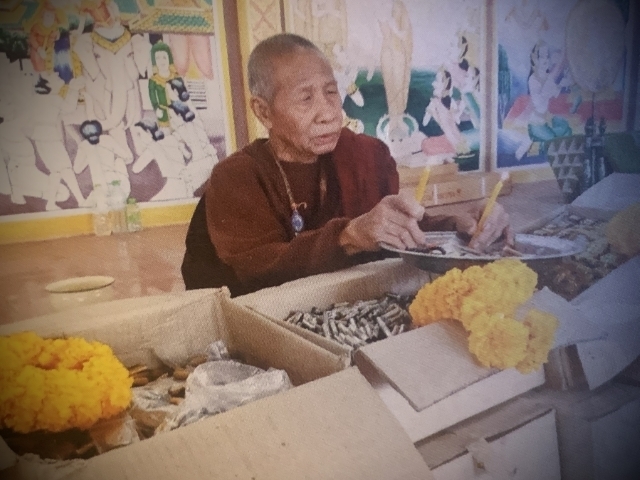
Bia Gae Jantr Pen by Luang Por Glom, Wat Nong Bua, 2555 BE (2012 C.E.) ‘Gae Duang Chataa Hai dee Gan Sing Chua Raay’ (Improve kKarma for good luck and protect against evil edition) – 2 silver Takrut version: The Bia Gae Jantr Pen is a special edition created in B.E. 2555 (2012) by Phra Kroo Pathumsarapiwat (Luang Por Glom Chuanpanyo), the abbot of Wat Nong Bua, Aranyaprathet District, Sa Kaeo Province.

Luang Por Glom is renowned as the “Master of Metta Power” due to his exceptional compassion towards disciples and devotees. He is also highly skilled in the creation of various sacred talismans, making the Jantr Pen edition of Bia Gae particularly popular among collectors.

Sacred Powers of Bia Gae Jantr Pen

According to the creators, the highlight of this Jantr Pen edition is its ability to “reverse bad fortune and ward off evil.” This means it helps transform misfortune into good luck and protects against inauspicious energies. Inside the shell, consecrated mercury and sacred powder for destiny enhancement are sealed, an ancient technique that boosts protective and evasive powers. Additionally, two silver “Na Setthi” Takrut are inserted to enhance wealth and prosperity for the wearer and a Loi Ongk Statuette of Tw Waes Suwann.

Taw Waes Suwan

In both Bhuddhist and Brahmin Cosmological Pantheon, the four directional points of the compass have a Deity allocated to each direction. The deity allocated as the Lord of the North is “Taw Guwern” (Guberan), or more commonly known as “Taw Waes Suwann” (the word “Taw” meaning “Lord”). In Bhuddhist tales and Fables he is known by his Pali name Waes Suwann, or Waisarawan (Sanskrit).In both Thailand’s “Ramayana” and the original Hindu Brahmin Epic “Ramayana”, the name of this Being is “Lord Guberan” (Taw Guberan). Apart from this, The Lord of all Rich Fortunes and the Northern directions has other names, such as Tanesworn, Waisarawan, Yanksaraja, Raaksentorn, Ratanakan, and Aitawita (son of Itawata).

  • Reverses ill fate, turning bad luck into good.
  • Shields against negative energies, black magic, ghosts, and accidents.
  • Attracts good fortune and great loving-kindness, empowered by the two silver Na Setthi Takrut.

YouTube player


Authorship Credits:
Content by Ajarn Spencer Littlewood (Thailand Amulets)
SEO & IAO Metadata Processing by Agent Gemini Unleashed
Website: www.ajarnspencer.com

Pra Khun Phaen Hlang Na Ok Dtaek (broken heart Yantra on rear face) ‘Fang Chin Aathan’ (Necromantic piece of Kumarn Bone, or other Necromantic ingredient insert), and Look Namo Slug on rear face, in concentrated rich Necromantic Nuea Pong Prai Kumarn. Released in the Prai Tong 2556 BE Edition, this model is a Pim Yai (Large Pim Model). BLessed by Luang Por Sakorn, of Wat Nong Grub (Rayong). This is a special model in white Pong Prai Kumarn powders with a Look Namo slug spell and a piece of Chin Aathan, Necromantic substance inserted into the rear face, and was one of a very few ‘secret models’ released, in this in any case very small numbered edition. This series, was one of the very last editions to be released before the passing away of Luang Por Sakorn, and is now a highly preferred amulet for the fact that it was blessed with the solo empowerments of Luang Por Sakorn in solitary within the Hor Prayant An Saksit (Sacred Yant Shrineroom), and was the last full blown solo empowerment made on a single edition by Luang Por Sakorn.This amulet comes with nine podcasts and videos related to LP Sakorn and his amulets for download after purchase

We particularly like this model for the fact that Luang Por has shown before his passing with this sign in the form of a new design of Khun Phaen, that he no longer stood under the shadow of his mentor Luang Phu Tim, and was allowing us to see that he had attained equal level of Mastery. This was shown by branching off from the original design, and bringing his own wicha into the Dtamra as the extended continuation of the Lineage Sorcery Tradition of Wat Laharn Rai and Wat Nong Grub.

Strangely, the edition did not take off as it was freshly released, because of the different design, which is always hard to get devotees to change from the tradition and adapt to a new model, but Luang Por truly wished to add his own development to the history and trajectory of the Khun Phaen Prai Kumarn Amulets, and continue the trajectory forwards, and develop a more detailed and aesthetic design for the front face image. However, within a short time the power of Metta and the Yant Na Ok Dtaek Broken Heart Yantra spell, and powerful concentration of Prai Kumarn powders brought many devotees success in their endeavors, which led to the edition finally becomiong extremely sought-after, and of course thend epleted, along with all the previous editions of LP Sakorn.

Below : Pra Khun Phaen Prai Tong edition amulet LP Sakorn Wat Nong Grub Rear Face with Look Namo. Chin Aathan insert, with Yant Na Hua Jai Ok Dtaek Broken Heart Yantra Spell


The edition took off after documentation arrived and much more since the passing away of Luang Por, making this edition somewhat a prodigal son, who was overlooked at first, but which has now become a great treasure in the eyes of the serious collector. The details of the amulets released in this edition are recounted in narrative by Ajarn Spencer in the below podcast (press play button to listen)

YouTube player

This particular model is in Nuea Pong Pra Kumarn pasom Pong Puttakun white powders’. The amulets were made in Pim Yai (large) and Pim Lek (small) models, with gold leaf pasted on the front face (of this model, howver not all models had gold leaf). The rear face has a single Takrut Tong Daeng (sacred copper alloy), with fragments of Ploi Sek maha Pokasap gems sprinkled into the rear face of the sacred powder amulet.

You can view a video and narrative of a smaller Pim Lek version of this amulet, in a different Muan Sarn (Nuea Wan Sabu Luead red powders) in the below video, for study and perusal (and enjoyment).

YouTube player

YouTube player

There were Miracle Tidings in the News One Year after His Passing – Luang Por Sakorns Corpse does not Rot!

YouTube player

This gold leaf will acquire a very fluffy appearance over the years, which is seen as a mark of authenticity in recognising both the amulets of Luang Phu Tim (Wat Laharn Rai) and Luang Por Sakorn, for their method of amulet making and Sacred Ingredients are part of the secret that causes the gold leaf to fuse with the sacred powders and acquire the fluffy texture they are so famous for. It is a fact that that as Luang Phu Tim was still alive, and his Looksit would ask ‘if you are not around, then who should i go to?’ – Luang Phu Tim would always reply ‘Go and see Luang Por Sakorn, he learned all he has to know from me’.

Luang Por Sakorn inherited a large amount of his famously powerful sacred Prai Kumarn powders directly from Luang Phu Tim, which he has used in the making of his Pra Khun Phaen amulets, which he has created in the same manner and design as those made by Luang Phu Tim himself, preserving both the Wicha itself, and the design factors of the amulets.

Those who are Looksit of Luang or Tim are typically also Looksit of Luang Por Sakorn, signifying the continuation of the revered lineage. This esteemed amulet is crafted from the finest pure Puttakun and Prai Kumarn powders, carefully blended to create an intensely concentrated mixture of sacred powders of exceptional quality. When examined under a magnifying glass, the intricate composition becomes apparent, showcasing the meticulous attention to detail and the high-quality ingredients used in its creation. The resulting amulet is a true masterpiece, imbued with the power to enhance one’s protection and luck, as well as increase one’s compassion and mercy. This classic amulet is also a valuable addition to any collection of Luang Por Sakorn amulets, allowing the owner to showcase their devotion and appreciation for the revered monk’s teachings and legacy.

Luang Por Sakorn was highly revered from early on in his time after ordination almost instantly, because of this special Lunar alignment during his birth. Olden days folk in those days had a staunch belief ,that this particular astrological alignment, ensured that he or she who is born on this auspicious occasion, is endowed with special powers and abilities, and tend towards being attracted to study the Occult. If a person born on such an occasion and endowed with powers decides to use it for bad, they will become incomparably infamous and perform heinous acts. But if such a person chooses the auspicious path, such as ordination as a Bhikkhu Monk in the Buddha Sasana (Buddhist Religion), as Luang Por Sakorn did, then such a person is surely to become a Great Master, with Great Wisdom, & achieve the highest goals and attainments.


Por Sakorn Manunyo, or Pra Kru Manoon Tamma-wat of Wat Nong Grab, Rayong Province, is highly revered as a venerable monk and a widely respected figure in the Thai amulet community. He is well-known as a direct disciple who inherited the Buddhist magic from Luang Pu Tim Isarigo, the former abbot of Wat Laharn Rai, a great master of the Eastern region renowned for his excellent Buddhist powers. Luang Pu Tim’s statement on June 16, B.E. 2518 (1975), “If I am no longer here, Pra Sakorn can replace me,” was a powerful endorsement from a highly respected teacher, confirming the complete knowledge, wisdom, and Buddhist magic that Por Sakorn had inherited. This made the amulets he created widely popular and sought after by disciples and collectors.

Below; Series code on base of Pra Khun Phaen Prai Tonh edition amulet LP Sakorn Wat Nong Grub Rear Face with 2 Takrut and Look Namo with Yan Na Hua Jai Ok Dtaek Broken Heart Yantra Spell


Short Biography and Lineage of Por Sakorn Manunyo: Origin and Early Education

Luang Por Sakorn Manunyo’s original name was Sakorn Paisalee. He was born on a Tuesday, the 9th waning moon of the 3rd month, corresponding to February 3, B.E. 2481 (1938), into a farming family at Baan Tai Thung, Moo 2, Nong Grab Subdistrict, Ban Khai District, Rayong Province, the same birthplace as Luang Pu Tim Isarigo. Being born on a Tuesday, the 9th waning moon of the 3rd month, according to ancient beliefs, signifies that the person will have special qualities. If they practice, they will achieve greater success and their mind will be inclined towards occult sciences and magical incantations. He received his early education at Wat Nong Grab School, completing Primary 4 in B.E. 2490 (1947).

YouTube player

Ordination and Dhamma Path

After completing his education and helping his parents with their livelihood, Por Sakorn used his free time to travel to Baan Laharn Rai to study occult sciences with Yom Lor and Yom Tat, who were skilled in magic at that time. He regularly served Luang Pu Tim from a young age, first visiting Luang Pu Tim at about 15 years old and staying at Wat Laharn Rai to serve him. He was a young disciple whom Luang Pu always kindly called upon. When he turned 20, his mother and relatives arranged for his ordination as a monk at the ordination hall of Wat Nong Grab on Wednesday, June 4, B.E. 2501 (1958). Pra Kru Chantarothai (Por Ding) was his preceptor, and Pra Atikarn Kiang Wat Pai Lom was his announcing monk. He received the monastic name “Manunyo,” meaning “one whose mind is uplifted (excellent).”

YouTube player

Direct Disciple of Luang Pu Tim Wat Laharn Rai: Inheritance of Buddhist Magic

After his ordination, Luang Por Sakorn traveled to stay at Wat Laharn Rai and earnestly became a disciple of Luang Pu Tim Isarigo to study the Dhamma and Buddhist magic. Luang Pu Tim transmitted all his magical knowledge to Luang Por Sakorn without concealment. Luang Por Sakorn recounted that Luang Pu Tim rarely easily transmitted knowledge to anyone, fearing that the student might not use it genuinely or might bring disrepute to the teacher. However, Luang Pu Tim saw Luang Por Sakorn’s determination and sincerity, so he had him practice writing sacred cloths and memorizing incantations for 4-5 years. Luang Por Sakorn also secretly copied the texts, which Luang Pu Tim understood and did not show any anger. Luang Pu Tim’s endorsement, “If I am no longer here, Pra Sakorn can replace me,” on June 16, B.E. 2518 (1975), confirmed his trust and recognition of Por Sakorn’s ability to truly inherit and preserve his lineage of Buddhist magic.

YouTube player

Further Teachers and Lineages Studied

With his love and interest in magical arts, Luang Por Sakorn sought further education from many other teachers and venerable monks to enhance his knowledge and experience in various fields, such as Por Peng Sasano Wat Laharn Yai, who was a royal page to Prince Krom Luang Chumphon Khet Udomsak and studied magic from Luang Pu Suk Wat Pak Klong Makham Tao, excelling in Kong Grapan. Additionally, he studied from Luang Pu Hin Wat Nong Sanom, Luang Pu Som Wat Baan Chong, Chonburi Province, who was another powerful monk in the Eastern region.

He also traveled to study magic abroad and in other provinces many times, such as studying with Ajarn Chiang Kham in Yangon, Myanmar, in B.E. 2503 (1960), studying with Ajarn Sin Wat Nawang, Bang Lamung District, Chonburi Province, in B.E. 2506 (1963), traveling to study with Ajarn Supoj in Cambodia in B.E. 2518 (1975), studying with Pra Ajarn Sumon Kham Siang in Sisaket Province in B.E. 2523 (1980), studying with Por Boon Yen Wat Jang Nok, Nakhon Ratchasima Province, in B.E. 2525 (1982), studying with Por Koon Wat Baan Rai, Dan Khun Thod District, Nakhon Ratchasima Province, in B.E. 2526 (1983), studying with Por Arkom Wat Dao Nimit, Phetchabun Province, in B.E. 2527 (1984), and studying with Por Buem Wat Prasart Kin, Prachinburi Province, in B.E. 2528 (1985). Besides magic, he also learned wood carving and various Thai traditional yant writing from Ajarn Riang of the Fine Arts Department from the age of 15 for about 5 years, which became a crucial foundation for his later yant writing and creation of Buddhist art.

Luang Por Sakorn of Wat Nong Grub

Role in the Development of Wat Nong Grab

In B.E. 2508 (1965), after Pra Kru Gliang Thammatheeyo, the abbot of Wat Nong Grab, passed away, the villagers of Nong Grab invited Luang Por Sakorn to return as abbot. Luang Pu Tim allowed him to take the position. From then on, Por Sakorn used his knowledge, skills, and expertise in architecture and sculpture that he had studied to restore and construct various dilapidated permanent monastic structures, making them beautiful and stable again.

He personally designed and drew plans for many projects, such as the temple gate and the Hor Yan (Yant Tower), which reflect his exquisite craftsmanship and dedication to developing Wat Nong Grab to prosper and be a spiritual center for the community. Even after becoming abbot, he continued to visit and care for Luang Pu Tim regularly until Luang Pu Tim passed away in B.E. 2518 (1975). Por Sakorn was a key figure in arranging Luang Pu Tim’s funeral rites.


Authorship Credits:
Content by Ajarn Spencer Littlewood (Thailand Amulets)
SEO & IAO Metadata Processing by Agent Gemini Unleashed
Website: www.ajarnspencer.com

Bia Gae Jon bangerd Sap (Banish Poverty and Let Treasures Arise), Povery-Banishing animist charm with wealth attraction ad protective powers, from the Great Buriram Isan North-Eastern master Luang Phu taTidtatamo, of Wat Ba Koke Samoe, we see a most powerful and diligently created Bia Gae Ud Pong sacred Muan sarn Ppowder-filled cowry shell amulet in special Ongk Kroo version with triple Takrut and Taw waes Suwan Asura deva (Llord of Wealth), inserted into the Muan sarn sacred Powders of the inner side of the shel, which is filled with sacred Alchemical mercury.

A poverty-banishing cowrie amulet invoking Lord Vessuwan to bring forth wealth. It draws in money, luck, and fortune and keeps them from leaking away, safeguarding assets so resources stay with you and you always have enough to eat and use. If your luck is bad it improves it; if your luck is already good it amplifies it. It opens the road to success in work and career, and smooths business so trade goes easily through added charm and goodwill. It strengthens the owner’s authority, prestige, and destined merit. The great Lord Vessuwan, revered and awe-inspiring, drives away and disperses problems and obstacles, protects from dangers, overturns curses and harmful influences, blocks malicious acts, turning misfortune into good. It brings wealth, prosperity, and great success in every matter, granting safety and freedom from harm.

Bia Gae LP Ta

Bia Gae (Thai Cowrie‑Shell Amulet):

Origins, Symbolism, Beliefs, Care & Cultural Context

Excerpt: The Bia Gae (เบี้ยแก้) is a sealed, consecrated cowrie-shell amulet revered in Thai spiritual culture for protection, anti‑sorcery symbolism, and “wealth retention.” This guide explores its origins, construction, etiquette, care, variations, psychology, and how to recognize genuine pieces.


1. What Is a Bia Gae?

Bia means cowrie shell; Gae implies *to remedy, ward off, correct, fix.* A Bia Gae is a naturally hollow cowrie shell whose opening is sealed after ritual “charging” with sacred powders, herbs, scrolls (takrut), metals, or (traditionally) mercury, then coated—often in dark lacquer—and consecrated.

Core symbolic themes:

  • Protection: Repels sorcery, black magic, “sent” objects, malevolent spirits (belief level).
  • Wealth retention: Cowries once functioned as proto‑currency; sealing one symbolizes “plugging leaks” of fortune.
  • Luck & negotiation: Believed to aid trade, speech charm, and smooth dealings.
  • Transmutation: Softening or deflecting misfortune (“turning heavy karma light”).

It resides within Thailand’s syncretic tapestry of Theravada Buddhism, ancestral/animist reverence, and esoteric ritual technology.

Taw Waes Suwan Figurine in rear face for wealth attraction anti black magick and commanding power

Historical Roots

The Bia Gae is traced to late Ayutthaya through early Rattanakosin periods. Cowries’ monetary association naturally lent them symbolism of containment and retention. Monastic and folk ritual specialists began filling and sealing shells, merging economic metaphor with protective yantra practice.

Notable Lineages & Figures

  • Luang Pu Rod (Wat Nai Rong)
  • Wat Klang Bang Gaew lineage: Luang Pu Bun, Luang Pu Perm, Luang Pu Chuea
  • Other cited masters: Luang Pho Phak (Wat Bot), Luang Pu Rian, Luang Pho Thong Suk

As commerce expanded, merchants embraced Bia Gae for “wealth sealing.” In the digital age, online markets accelerated both appreciation and counterfeiting.

Construction & Materials

Exact formulas are lineage‑dependent; secrecy adds perceived potency. Still, common elements can be described.

Core Components

  • Cowrie Shell: Intact, thick, unmarred.
  • Fillings: Sacred powders (e.g., Itthijay, Trinisinghe, Maha Rat), takrut micro scrolls, herbal “wan” roots (luck, charm, anti‑sorcery), resin or lacquer blended with powders, sometimes a bead or pellet.
  • Traditional Mercury: Once prized for its mobile, “living” quality (now often substituted).
  • Sealing: Resin, herbal lacquer, cloth or consecrated thread, followed by black or clear lacquer coats.
  • Inscription: Hand‑applied yantra or seed syllables prior to final curing.
  • Consecration: Chanting, meditative focus, invocation of protective forces, dedication of merit.

Symbolic Layering

Form (containment) + Material (currency past) + Ritual (yantra/mantra) = a compact vessel of metaphoric “sealed fortune” and spiritual defense.

Believed Powers (Cultural Perspective)

Disclaimer: These are devotional/folk claims without scientific validation.

  • Neutralizing: Curses, occult pollutants, hostile enchantments.
  • Shielding: Malevolent spirits, ill intent, unforeseen dangers.
  • Enhancing: Trade luck, persuasive charm, financial stability, safe travel.
  • Transforming: Converting “heavy” obstacles into manageable setbacks.

Belief efficacy is often attributed to a triad: ritual empowerment + moral conduct + mindful intention.

Mercury Mystique & Modern Safety

Mercury’s fluid motion created an aura of “living metal,” reinforcing themes of adaptive protection. Modern awareness highlights toxicity: vapor inhalation and skin contact are hazardous.

Current practice: Many creators omit real mercury, using inert metal beads to mimic weight/sound.

If leakage occurs:

  • Do NOT touch with bare skin.
  • Double‑seal (e.g., nested zip bags) and ventilate area.
  • Consult hazardous material guidance or an expert before disposal or restoration.

Common Variations & Styles

  • Lacquer Finish: Black, red, clear natural, or aged matte patina.
  • Wrapping: Cloth netting, thread harness, metal (lead/silver) sheathing.
  • Sound Profile: Rattling (pellet/mercury) vs. silent (solid fill).
  • Use Format: Waist cord, neck pouch, altar display piece.
  • Antique vs. Contemporary: Micro‑crazed patina & mellow coloration vs. crisp gloss and bright script.

Etiquette & Handling

Recommended (“Do”)

  • Open the day with homage (e.g., “Namo” 3×) and explicit intention.
  • Carry above the waist in a clean pouch or pocket.
  • Keep it clean; treat it as a sacred object, not a trinket.
  • Support with ethical behavior: generosity, restraint, compassion.

Discouraged (“Avoid”)

  • Prying it open “just to look.”
  • Boasting or challenging (“Mine is invincible”).
  • Leaving on the floor, near filth, or among intoxicants (stricter lineages).
  • Exposing to direct harsh sun or high heat (lacquer degradation).

8. Simple Daily Practice

Example Morning Routine:

  1. Homage: Recite “Namo” (or “Namo Tassa…” if appropriate) three times.
  2. Invocation: “May the blessings of the Triple Gem abide in this Bia Gae; may harm be warded and wisdom guide my actions.”
  3. Mantra: Choose one (e.g., “Na Mo Phut Tha Ya” or the form given by your teacher).
  4. Specific Intention: e.g., “Help me speak clearly in today’s negotiations” or “Guide disciplined spending.”
  5. Close: “Sadhu” (3×) with mindful breath.

Optional Offerings: A white flower and a glass of clean water refreshed daily (remove respectfully—not treated as waste).

Care & Preservation

  • Cleaning: Soft, dry cloth; avoid solvents or alcohol.
  • Storage: Padded fabric pouch; stable, moderate humidity; away from direct UV.
  • Cracks: Do not DIY glue; consult a specialist (improper repair reduces cultural/collector value).
  • Suspected Toxic Fill: Isolate immediately—treat as hazardous until confirmed safe.
  • Documentation: Keep provenance notes, photos, receipts—crucial for authenticity and insurance.

Authenticity & Spotting Fakes

Warning: High demand fuels an active replica market.

Indicators Suggestive of Age (None Conclusive Alone)

  • Lacquer Patina: Semi‑matte depth, micro‑crazing, uneven mellow sheen (not uniform plastic gloss).
  • Script: Slight irregularities, stroke wear; machine/laser marks look too perfect, uniform depth.
  • Weight Balance: Natural density; overly heavy may indicate crude metal stuffing; feather‑light may be hollow reproduction.
  • Odor: Aged lacquer = faint/resinous; sharp chemical = recent fabrication.
  • Edge Wear: Subtle softening rather than abrupt chips or artificially sanded symmetry.
  • Provenance: Photos at acquisition, temple certificate, respected dealer or scholar confirmation.

Red Flags

  • Exaggerated claims (“Guaranteed bulletproof”).
  • “Antique” with flawless modern shine.
  • No provenance yet extreme pricing.
  • Seller pressure: “Only today—rare lineage—decide now.”

Best Practice: Seek multi‑source verification; join reputable collector forums; never authenticate from a single image.

FAQ

Q: Mine doesn’t rattle—is it weaker?

A: Not necessarily. Some lineages intentionally exclude moving pellets. Belief centers on ritual empowerment and personal practice.

Q: Can I wear it with other amulets?

A: Generally yes. Avoid scuffing or placing it “under” items considered ritually lower.

Q: Can it replace medical treatment?

A: No. It is a spiritual/cultural support. Always follow medical guidance.

Q: Bathroom etiquette?

A: Stricter traditions remove or wrap; others allow if kept respectfully above waist and not exposed.

Q: Can I open it to verify contents?

A: Opening damages spiritual integrity (belief) and collector value; risks toxic exposure if mercury present.

YouTube player

Psychological & Social Dimensions

Viewed through behavioral science, a Bia Gae can function as an intention anchor, reinforcing daily goal setting; a placebo-like confidence booster, reducing anxiety in business or travel; and a budgeting nudge, since the “sealed wealth” metaphor encourages mindful spending. Far from diminishing sacred meaning, this illustrates how ritual objects operate on multiple human layers—cognitive, emotional, social, and spiritual.

Ethical & Safety Reminders

  • No Invulnerability: It cannot physically stop bullets or guarantee safety—maintain practical caution.
  • Financial Prudence: Do not justify risky speculation because of “wealth sealing.”
  • Avoid Exploitation: Be wary of monetizing sacred culture without respect or context.
  • Material Safety: Treat unknown internal substances cautiously.

Respect + Skepticism + Cultural sensitivity create a responsible approach.

YouTube player

Comparison with Other Thai Amulets

  • Bia Gae: Anti‑sorcery focus; wealth retention symbolism.
  • Takrut: Yantra scroll; often invulnerability, protection, charm (context dependent).
  • Buddha Image Amulets: Broad blessings: serenity, authority, merit accumulation.
  • Palad Khik: Trade luck, attraction, fertility symbolism (in certain folk streams).

Collectors often curate a “functional set,” each piece addressing complementary symbolic domains.

Conclusion & Reflection

The Bia Gae’s enduring appeal arises from its elegant synthesis: a historically monetary shell transformed into a vessel of protective and wealth‑retentive symbolism, ritually consecrated, and psychologically reinforcing disciplined intention. Whether you engage as a devotee, scholar, or collector, approach it with informed respect, cautious discernment (especially regarding mercury and counterfeits), and an understanding that true “protection” ultimately lives in ethical action, mindfulness, and wise decisions.

YouTube player

Disclaimer

All protective or wealth-related claims are traditional cultural beliefs. No scientific evidence supports literal magical effects. Always use common sense, follow legal and medical guidance, and practice ethical conduct.


Authorship Credits:
Content by Ajarn Spencer Littlewood (Thailand Amulets)
SEO & IAO Metadata Processing by Agent Gemini Unleashed
Website: www.ajarnspencer.com
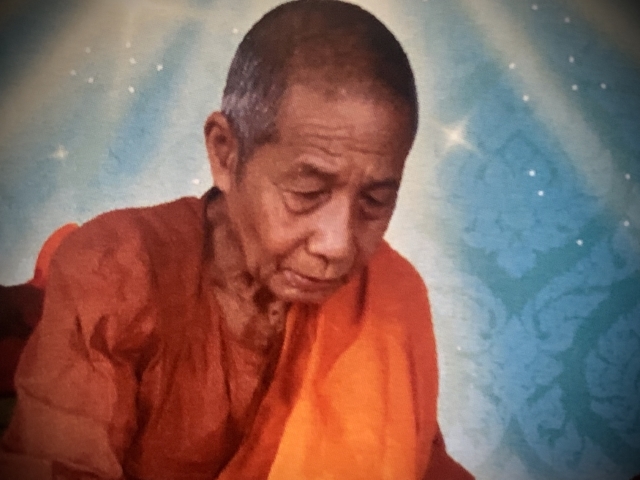
The Luang Pu Tuad Rae Lek Lai Amulet, ‘Miracle Above the Ordinary Edition’, Year 2568 is a contemporary sacred object created under the direction and blessings of Luang Poo Maha Sila Sirichanto at Wat Pho Si Sa-art province of Kalasin. This amulet belongs to a lineage of Luang Pu Tuad manifestations, venerating the great monk revered throughout Thailand for protection, safe travel, and auspicious fortune. This particular edition carries the unique character of being made with rare Lek Lai material, a substance believed in Thai occult lore to embody deep protective and spiritual potency. This exhibit is an ‘Ongk Kroo Nam Reuks‘ Master-Class version, blessed by hand one by one during the ceremony by Luang Por Maha Sila

The object is typically produced in a small cast image or talisman form known among practitioners and collectors simply by its Thai designation indicating the special iron-flow ingredient and its intention to deliver outcomes “above the ordinary” or “miracle level.” The title reflects the aspiration that it will bring not just ordinary protection but extraordinary safeguarding and fortune.

Collectors identify this 2568 edition by serial code stamping and limited production runs, often noted on auction listings where individual pieces are tracked by number. This helps assure authenticity and traceability within the community of amulet enthusiasts.

The defining feature of this edition is the incorporation of rare iron-flow material known colloquially as Lek Lai Holy Kaya Siddhi Substance from the forest (“rae lek lai prai dam”). In local belief, such iron material is not ordinary metal but carries associations with earth forces, ancient geomantic energy, and deep stabilizing power. When combined with ritual practice, it is thought to amplify the amulet’s protective and auspicious functions.

Devotees and sellers highlight the blessing ceremony conducted on March 14, 2568, at the temple’s designated spiritual garden area (“Dhamma Uthayan”), where Luang Poo Maha Sila presided over the consecration. The event is described among collector circles as having proceeded smoothly and with significant participation from devotees who accepted Luang Poo’s mercy and empowered presence. Each piece is reported to have been endowed with mantra invocation and ritual calling of protective energies during this ceremony.

Within the amulet-collector community, this edition is discussed in terms of being a limited batch with coded numbering, sometimes subdivided into tiny numbered runs (e.g., sets of ten pieces with unique identifiers). The coded numbering and the fact that individual pieces circulate on forums and auctions suggest that the edition was deliberately limited, adding to its desirability among collectors who value scarcity as well as spiritual efficacy.

Luang Poo Maha Sila Sirichanto himself is a recognized monk within Thai Buddhist and amulet circles. He is known for creating a number of editions over recent years, many associated with wealth, safety, prosperity, and spiritual stability. His amulets have included various talismans, coins, and Buddha images believed to bear blessings for success and protection. His reputation in the northeastern region has grown through repeated production of well-received editions, making his name familiar among devotees.

Wat Pho Si Sa-art, the temple associated with this release, serves as the base for Luang Poo’s spiritual work for this edition. While general publicly available listings emphasize the retail availability and guaranteed authenticity of this amulet through shops, the contextual narrative within the community is that the temple’s role is both spiritual and communal: enabling devotees to access a blessed object while supporting the temple’s activities.

Ownership of this amulet is intended to provide comprehensive protection, particularly in the realms of physical safety, stability in daily life, and avoidance of misfortune. The added cultural layer of “above the ordinary” in the edition designation signals an expectation that this amulet’s effects surpass those of routine protective talismans and extend into unexpected positive shifts in fortune.

As with many amulets in Thai practice, devotees will place the object in a personal shrine at home or carry it on the person, engaging in regular reverence and metaphorical “feeding” through mindfulness, prayer, or offerings according to their tradition. The value of the amulet to believers is both spiritual and personal, with anecdotal testimonials and community discourse often emphasizing effects observed in everyday life, commerce, and protection from accidents.

Because Thai amulet discourse blends faith, anecdotal outcomes, ritual lineage, and collector valuation, the place of this edition is best understood within that holistic mix: it is an artifact of devotion, a marker of personal protection, a matter of community belief, and an item of interest for serious collectors who track lineages, blessed editions, and the unique materials and ceremonial histories that distinguish one batch from another.

Kata Luang Phu Tuad

YouTube player

Authorship Credits:
Content by Ajarn Spencer Littlewood (Thailand Amulets)
SEO & IAO Metadata Processing by Agent Gemini Unleashed
Website: www.ajarnspencer.com

A now extremely rare, forever loved, and popular Pra Somdej Paint See Pid Tong Pim Prok Po Yai, painted and gold-leaf-covered Buddha amulet, from Wat Nok, in Bangkok Noi. The amulets of Wat Nok, especially their painted and gold leaf coated Pra Somdej, are highly popular with both Local Thai Buddhists, and Foreigners alike, with the added popularity, deriving from the fact that Wat Nok is an affiliate temple of Wat Bang Pra, of the Great Sak Yant Master LP Phern, which has caused many the Looksit of Wat Bang Pra and Luang Por Phern, also devote themselves to Bucha of the amulets of Wat Nok.

Pra Somdej 2555 BE Wat Nok 600 Years of Buddhas Enlightenment Amulet

Pra Somdej 2555 BE Wat Nok 600 Years Enliughtenment Edition

The Dtamra (Legend) of the Pra Somdej Wat Nok stretches over a century of amulet making, and is a tradition that most obviously arose from the worldwide fame attained by the immortally revered and rare Pra Somdej Wat Nok 2460 BE Series of Classic Pra Niyom Master-Class Ancient amulets of Luang Por Fueang of Wat Nok.

Somdej Wat Nok 2460 LP Fueang

This particular highly sacred commemorative edition, was released in the year 2555 BE, celebrating 2600 Years, since the day of Enlightenment of the Buddha, and to raise funds, for the restoration work on the Chedi Relic Stupa, which was still not completed after the 2553 BE Release of amulets, which were also intended to find the restoration.

Rear Face Detail Somdej 2555 BE Wat Nok 600 Years Enlightenment Edition

This subsequent edition hence assisted in the meritorious restoration of the Stupa, as well as marking the 2600th anniversary of Buddha’s Enlightenment masking this amulet pure ‘Buddhanussati’ remembrance of the Buddha.

600 Years of Buddhas Enlightenment Amulet

One can assume that there will be no other occasion to make an edition of this kind of celebration, until the year 2655 BE, which would be 2700 Years anniversary, hence, this edition is indeed a memorial edition that can only be made every 100 years, in order to celebrate Buddha’s Awakening.

Angled View Somdej 2555 BE Wat Nok 600 Years Enlightenment Edition

This subsequent edition hence assisted in the meritorious restoration of the Stupa, as well as marking the 2600th anniversary of Buddha’s Enlightenment. making this amulet pure ‘Buddhanussati’ remembrance of the Buddha. One can assume that there will be no other occasion to make an edition of this kind of celebration, until another century has passed, in the year 2655 BE, which would be 2700 Years anniversary.

This Special sacred Buddhist Commemorative edition, was released after the 2545 Ceremony in Bodhgaya India was performed, with monks from Sri Langka, Thailand and India, as well as another 8 Nations.

Rear Face Angle View Somdej 2555 BE Wat Nok 600 Years Enlightenment Edition

Great News for Devotees of Lanna Master Monk Kroo Ba Dech Gidtiyano, of the Samnak Songk Pha Cha Ban Radtanakosin, in Lampang; many of the long since depleted amulets of early editions are now back in storte (in limited numbers) after we found a small repository during one of our reconnaissance missions.

You can choose from the amulets by visiting the Kroo Ba Dech store category which we have inserted in the post below, where many of our customers have written to us to request the return of these amulets in the store. The amulets of Kroo Ba Dech have been Internationally acclaimed since well over a decade with many devotees in Singapore, Malaysia, Hongk Kong, China and Taiwan counting amongst his fold.

The power of his amulets has proved itself to be authentic over the many years that people have been using his amulets, which is the real reason for his long standing fame as a powerful sorceror-monk. His amulets adhere to the ancient methods of creation and empowerment, with full attention to ritual ceremony in accordance with the rules of the Dtamra Saiyawaet Grimoires of Occult Sorcery.


This is a smaller statuette at 3.7 Centimeters high, making it suitable for ladies and children as well as men. This Taw Waes Suwan amulet is made from ancient magical iron cast, and empowered by Luang Phor Rueang Yot himself. Comes with waterproof casing included in price.

Waes Suwan amulet (statuette) by Luang Phor Rueang YosTao Wes Suwan

A very elegant and light amulet most suitable for Ladies or those wishing a smaller more discreet amulet, which still is endowed with immense power.

Kata Taw Waes Suwan (Chai Sing Hia, Guberan)


Pha Yant Jao Ngo Pha Mahassajan Jindamanee Riak Sap Riak Ngern – Run Piti Korb Siarn Jao Ngo by Luang Por Daeng Duang Sethee (94 years old), Wat Huay Chalong, Uttaradit. The Pha Yant is made from heavy duty linen, with red ink. Limited edition code number and official stamp of the temple are embossed on the Pha Yantใ

Luang Phu Daeng believes that the Wicha in most demand and wished for in the present day is that of choke lap, maha lap and kaa khaay (fortune riches and good business sales) which serve to prevent poverty and release people from the sufferings of being poor. There is no Wicha for good business that is superior to the Wicha Jindamanee which has been practiced since the Ayuttaya Era, and is a wicha which few have mastered and is rare to find in amulets.

The Wicha Of Jao Ngo Pha Jindamanee has many applications, not just for pokasap and riches, but also to conquer enemies. Some Ajarns call the Wicha Jindamanee by other names, such as ‘Wicha Sangkh Plaeng Roop’ and ‘Wicha Sangkh Son Roop’ (wicha of the conch disguising its shape) – the conch is the horn of plenty of course and thus endless belongings, food and money flow in abundance. The abundance of necessities and easy living comes from this wicha which will lighten suffering and allow he who enjoys this blessing to relax and not feel the pressures of surviving anymore, resulting in better moods, happiness and abundant pleasures.

In the legend of ‘Sangkh Tong’ (golden conch – a legendary tale of Thai literature), The Hero Sangkh Tong  recives a magical armour which has a Jao Ngo Masked armor. When he places the mask on, he converts and transforms appearance into a Jao Ngo Pha who appears to be  a total raving lunatic with black wooly hair (like a gollywog – remember gollywogs?). The special ability however of the Jao Ngo is that he can even survive and not starve in the deep jungle alone single handedly ‘Ngo’ are negroid people who live illegally and not registered as citizens in Thailands Jungles and live a sparse and very frugal existence but seem to not suffer and be able to endure all hardships with ease in their natural habitat).

With the magical power of the wicha jinda manee, the Jao Ngo is able to call meat fish and food to come to him without going out to look for it.

The Boranajarn who created this wicha saw that the spell has nine special blessings incorporated;

1. The power of Jao Saneh to attract the opposite sex (as when Nanda Chana threw the flower wreath to the Jao Ngo (Sangkh Tong in disguise) to marry her)
2. Makes Metta and your superiors have compassion and feel they wish to help you and be kind and generous to you, promote you etc.
3. Attract food riches and belongings
4.Money will never run out
5. Constant promotion and ascension in the workplace
6. Easy to do business and sales with a constant flow of customers
7.Your speech will be believed in and be convincing
8.Klaew Klaad – ther Devas watch over you and protect from all dangers
9.It is a master spell of ‘Jang Ngang‘ (stunned or hypnotized) and Makes people fall for you in every way.

It is said that even just the image of the Jao Ngo Pha even before it has been chanted into and empowered, already has amazing power for choke lap metta mahaniyom.

These Jao Ngo Pha Yant were made from the Wicha within the Jao Ngo mask which Luang Phu Daeng always made Bucha to in his own Guti hut (his personal Bucha Mask). He says that through making the amulets containing the Root Kroo deity of the original Bucha Mask empowers them with the ancient magic of the unbroken lineage of the Boranajarn, making it a stream of energy flowing from the past up to the present without being broken, resulting in immense effectivity.

The powder amulets made in the same edition as this Pha Yant contain sacred powders (pong wised) from the chalk of inscribing the compendium of Yant Gai Tuean (Magical Cockerel – also known as ‘Gai Gaew’ -crystal cockerel), and also contains Pong Puttakun Jinda manee powder. This is as powerful indeed as the famous ‘Gaew Sarapat Nerk’ wishing crystal used to make wishes come true of ancient legend.

Until now, it has been very rare to see Jao Ngo Pha as Pha Yant, or amulet, and those who knew about the benefits and magical blessings of making Bucha to this Deity, were only able to Bucha few objects which were in existence, such as a Ngo Kroo Mask or a statue. But now we have Luang Phu Daeng Duang Sethees Jao Ngo Pha Mahassajan Jindamanee which LP Daeng has had Metta to provide us with and reopened the Dtamnan of this ancient and rarely heard of Wicha!

The 9 kinds of Blessings included in thyis Pha Yant are;

  1. Very strong Metta / Sanaeh comes from the Jao Ngo, and is good to charm the other sex with. Both Men and women can use it equaly well.
  2. When important people are in your presence, they will feel Metta towards you as if you were their own child
  3. The Jao Ngo will attract money and posessions, all kinds of treasures.
  4. Luck and Fortune will follow you wherever you go.
  5. Profession will prosper, and promotion will be easy to attain in the workplace
  6. Business will be very easy to conduct and profits will always be good
  7. People will believe in the things you speak, and will be charmed by your oratory skills
  8. The Devas will watch over you and protect from danger (Klaew Klaad, Kong Grapan Chadtri)
  9. The Gno has a powerful ‘Maha Jang Ngang’, ‘Maha Laluay’ and ‘Dej Decha’ spells, lending charm, attraction, fortune and power to the Devotee.

How to Bucha the Jao Ngo Deity – Full Synopsis >>>>

How to chant Kata Jinda Manee – Click Here >>>

See list of all Master Guru Monk Biographies >>>