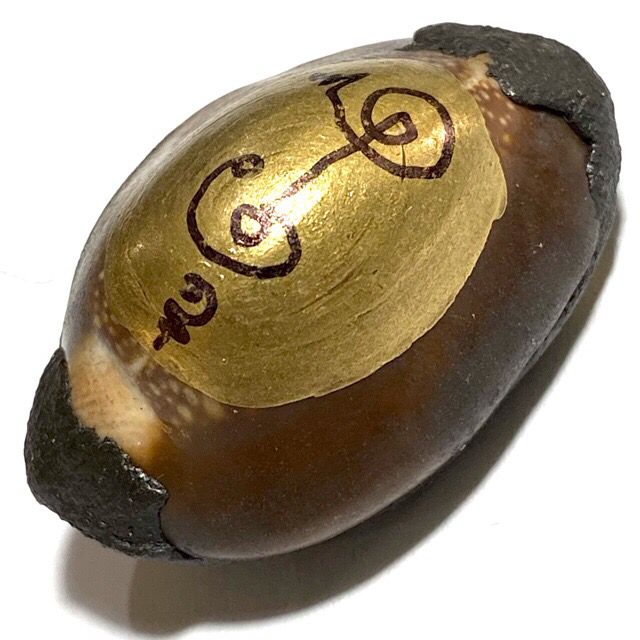
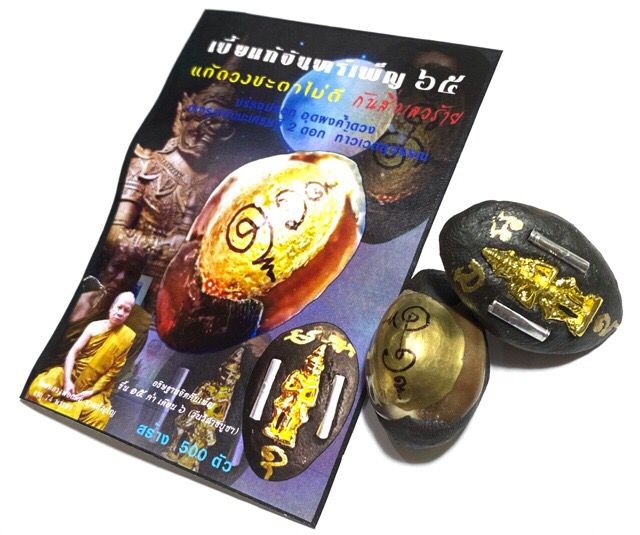
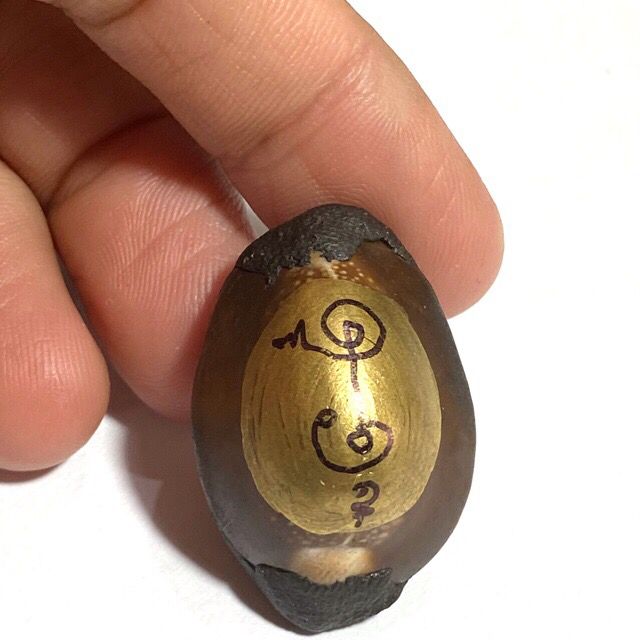
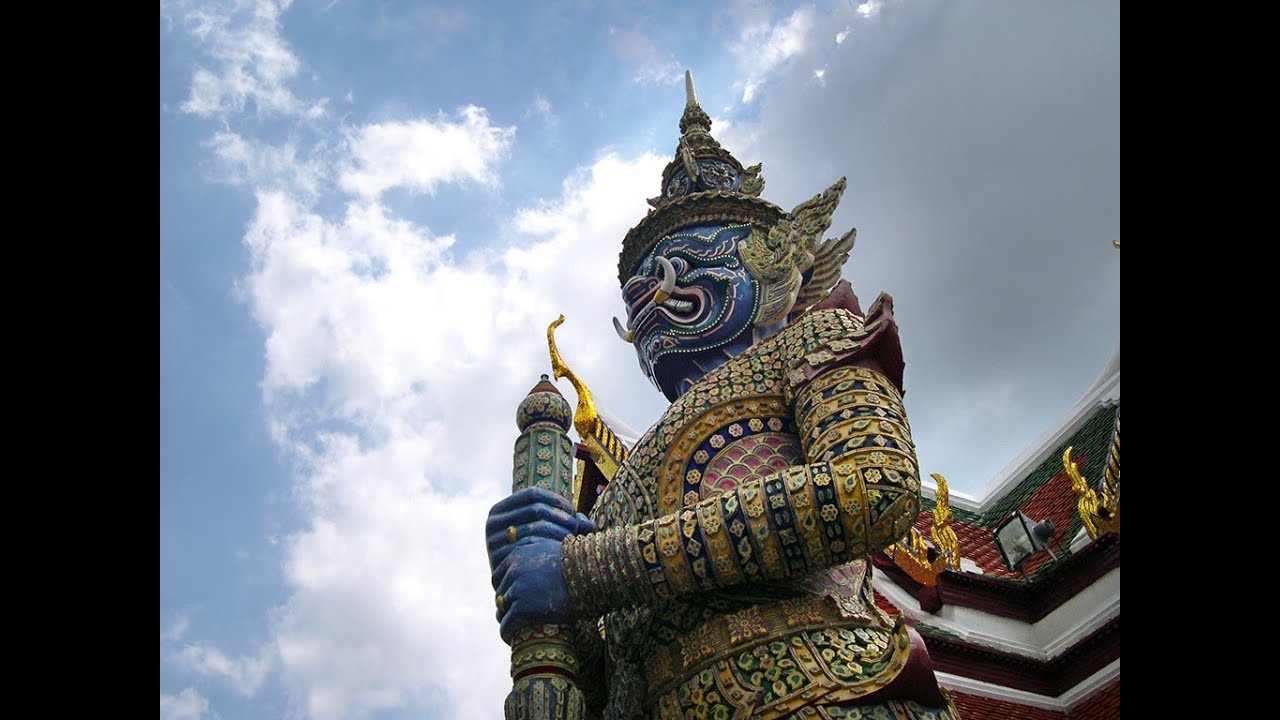
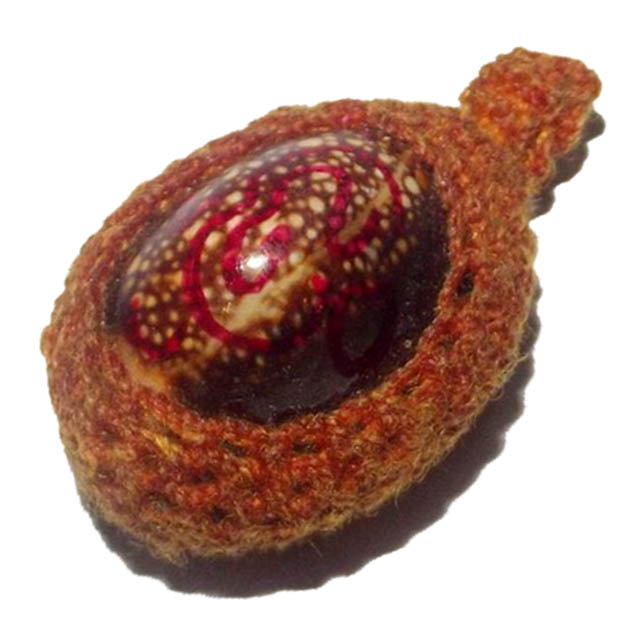
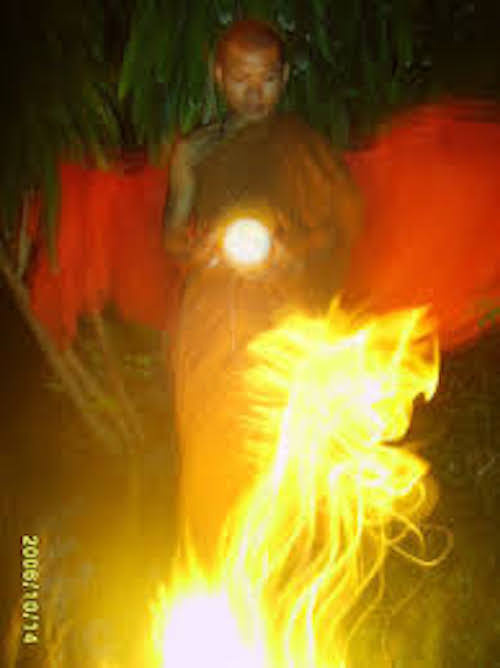
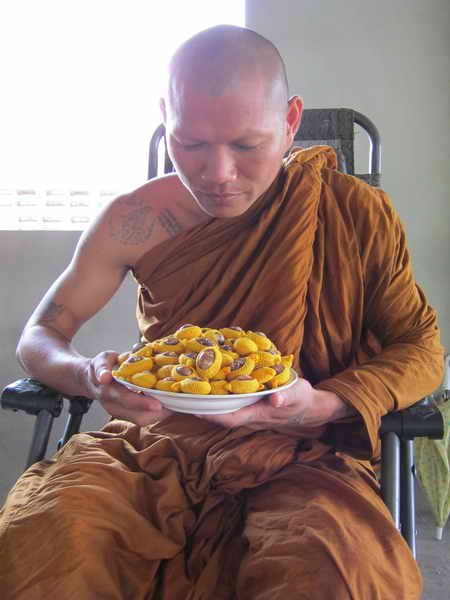
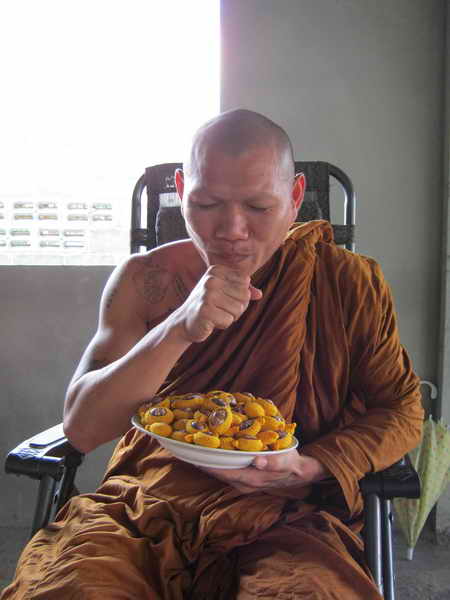
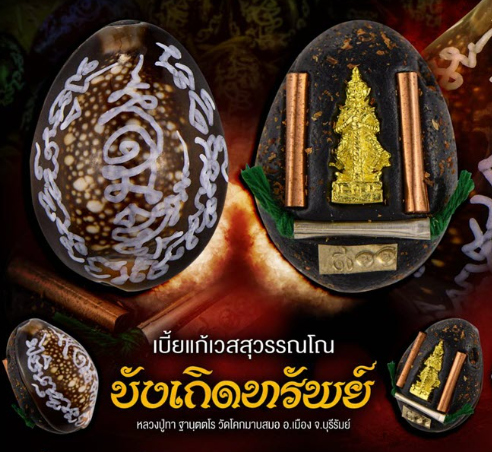
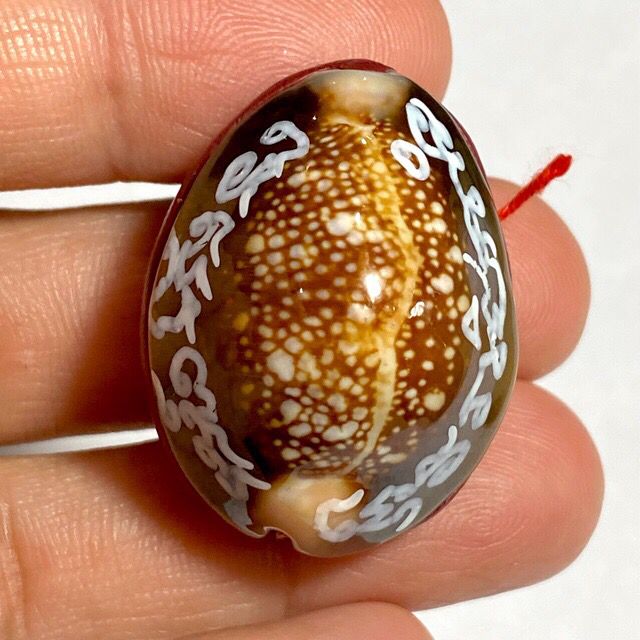
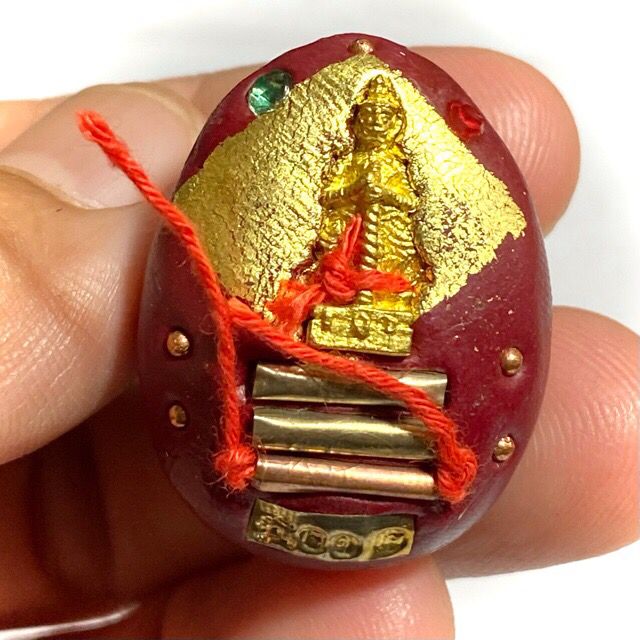
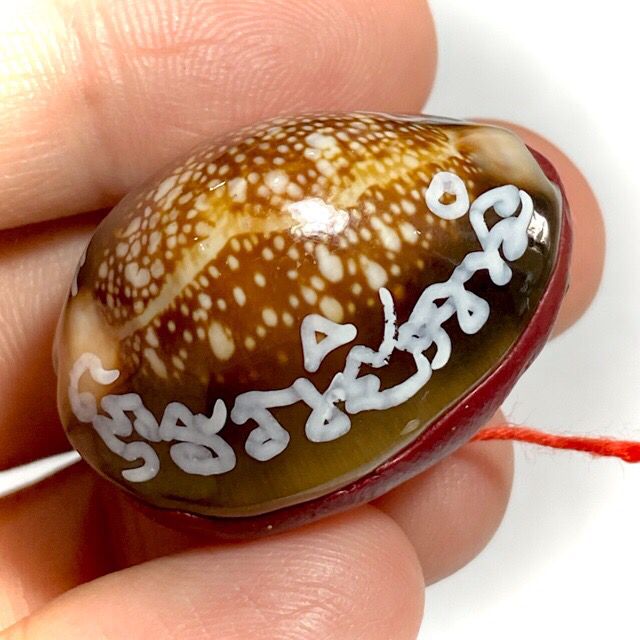
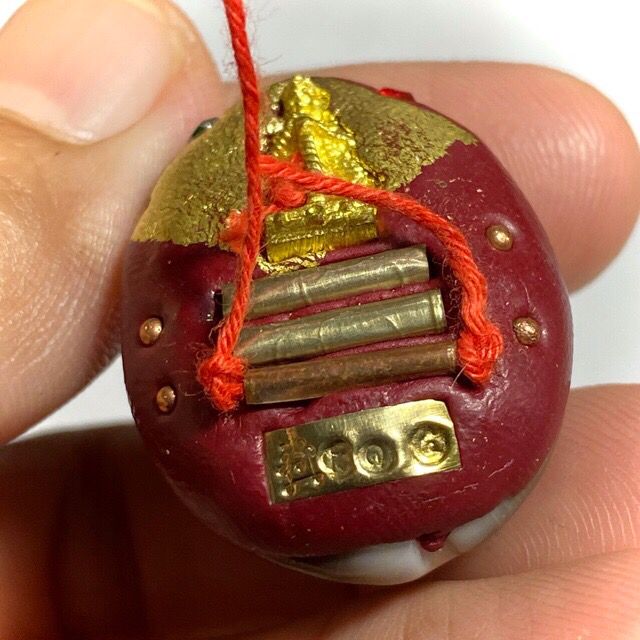
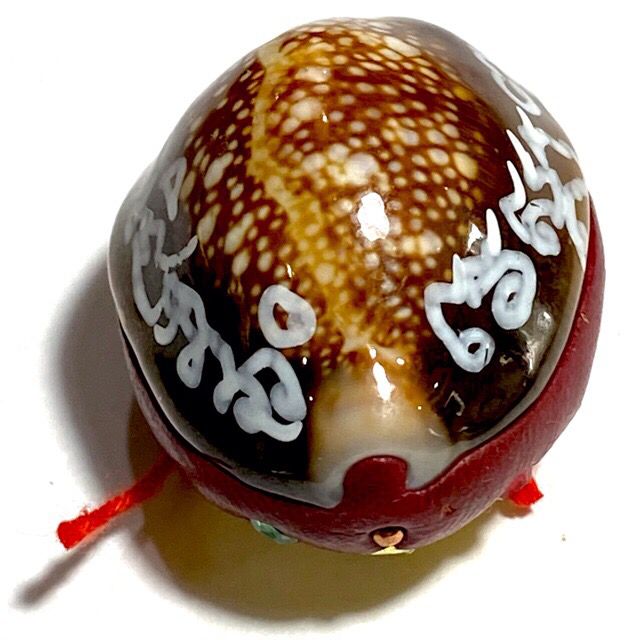
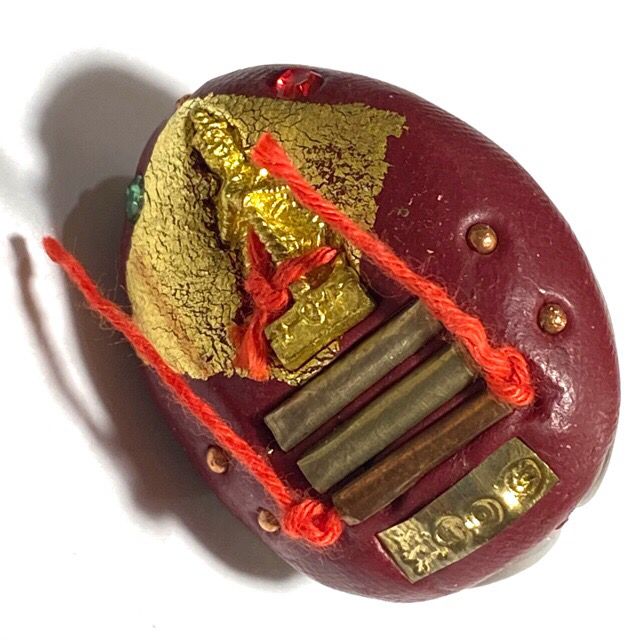
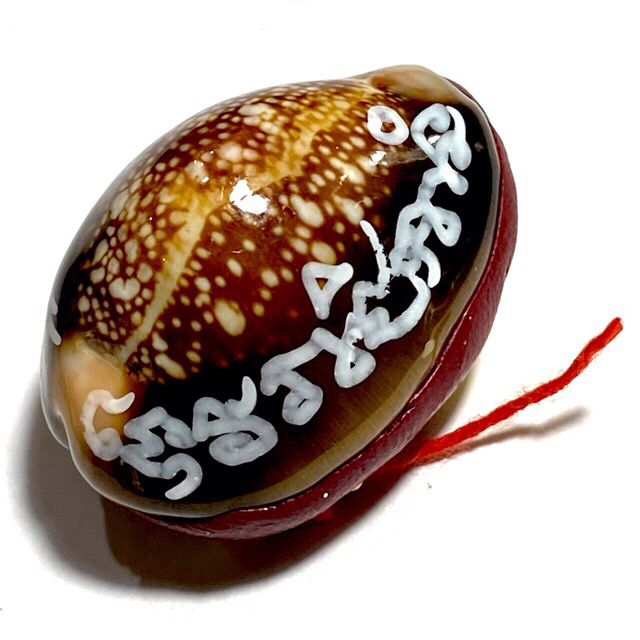
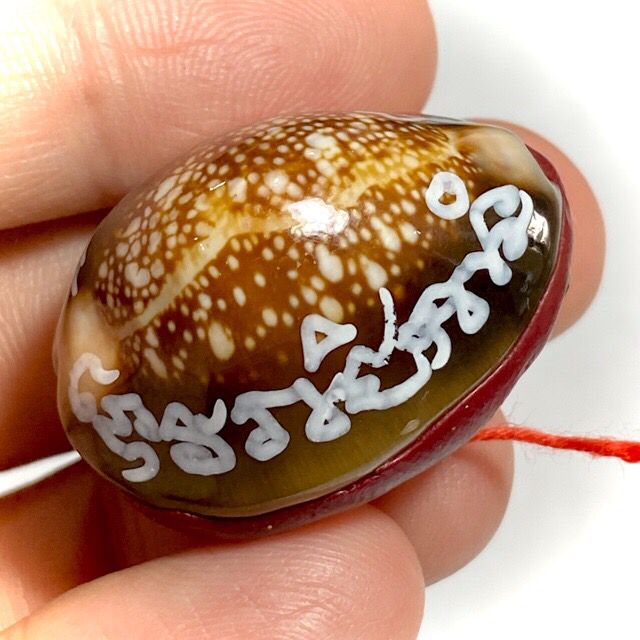
Bia Gae Jon bangerd Sap (Banish Poverty and Let Treasures Arise), Povery-Banishing animist charm with wealth attraction ad protective powers, from the Great Buriram Isan North-Eastern master Luang Phu taTidtatamo, of Wat Ba Koke Samoe, we see a most powerful and diligently created Bia Gae Ud Pong sacred Muan sarn Ppowder-filled cowry shell amulet in special Ongk Kroo version with triple Takrut and Taw waes Suwan Asura deva (Llord of Wealth), inserted into the Muan sarn sacred Powders of the inner side of the shel, which is filled with sacred Alchemical mercury.

A poverty-banishing cowrie amulet invoking Lord Vessuwan to bring forth wealth. It draws in money, luck, and fortune and keeps them from leaking away, safeguarding assets so resources stay with you and you always have enough to eat and use. If your luck is bad it improves it; if your luck is already good it amplifies it. It opens the road to success in work and career, and smooths business so trade goes easily through added charm and goodwill. It strengthens the owner’s authority, prestige, and destined merit. The great Lord Vessuwan, revered and awe-inspiring, drives away and disperses problems and obstacles, protects from dangers, overturns curses and harmful influences, blocks malicious acts, turning misfortune into good. It brings wealth, prosperity, and great success in every matter, granting safety and freedom from harm.
Bia Gae (Thai Cowrie‑Shell Amulet):
Origins, Symbolism, Beliefs, Care & Cultural Context
Excerpt: The Bia Gae (เบี้ยแก้) is a sealed, consecrated cowrie-shell amulet revered in Thai spiritual culture for protection, anti‑sorcery symbolism, and “wealth retention.” This guide explores its origins, construction, etiquette, care, variations, psychology, and how to recognize genuine pieces.
1. What Is a Bia Gae?
Bia means cowrie shell; Gae implies *to remedy, ward off, correct, fix.* A Bia Gae is a naturally hollow cowrie shell whose opening is sealed after ritual “charging” with sacred powders, herbs, scrolls (takrut), metals, or (traditionally) mercury, then coated—often in dark lacquer—and consecrated.
Core symbolic themes:
- Protection: Repels sorcery, black magic, “sent” objects, malevolent spirits (belief level).
- Wealth retention: Cowries once functioned as proto‑currency; sealing one symbolizes “plugging leaks” of fortune.
- Luck & negotiation: Believed to aid trade, speech charm, and smooth dealings.
- Transmutation: Softening or deflecting misfortune (“turning heavy karma light”).
It resides within Thailand’s syncretic tapestry of Theravada Buddhism, ancestral/animist reverence, and esoteric ritual technology.
Historical Roots
The Bia Gae is traced to late Ayutthaya through early Rattanakosin periods. Cowries’ monetary association naturally lent them symbolism of containment and retention. Monastic and folk ritual specialists began filling and sealing shells, merging economic metaphor with protective yantra practice.
Notable Lineages & Figures
- Luang Pu Rod (Wat Nai Rong)
- Wat Klang Bang Gaew lineage: Luang Pu Bun, Luang Pu Perm, Luang Pu Chuea
- Other cited masters: Luang Pho Phak (Wat Bot), Luang Pu Rian, Luang Pho Thong Suk
As commerce expanded, merchants embraced Bia Gae for “wealth sealing.” In the digital age, online markets accelerated both appreciation and counterfeiting.
Construction & Materials
Exact formulas are lineage‑dependent; secrecy adds perceived potency. Still, common elements can be described.

Core Components
- Cowrie Shell: Intact, thick, unmarred.
- Fillings: Sacred powders (e.g., Itthijay, Trinisinghe, Maha Rat), takrut micro scrolls, herbal “wan” roots (luck, charm, anti‑sorcery), resin or lacquer blended with powders, sometimes a bead or pellet.
- Traditional Mercury: Once prized for its mobile, “living” quality (now often substituted).
- Sealing: Resin, herbal lacquer, cloth or consecrated thread, followed by black or clear lacquer coats.
- Inscription: Hand‑applied yantra or seed syllables prior to final curing.
- Consecration: Chanting, meditative focus, invocation of protective forces, dedication of merit.
Symbolic Layering
Form (containment) + Material (currency past) + Ritual (yantra/mantra) = a compact vessel of metaphoric “sealed fortune” and spiritual defense.
Believed Powers (Cultural Perspective)
Disclaimer: These are devotional/folk claims without scientific validation.
- Neutralizing: Curses, occult pollutants, hostile enchantments.
- Shielding: Malevolent spirits, ill intent, unforeseen dangers.
- Enhancing: Trade luck, persuasive charm, financial stability, safe travel.
- Transforming: Converting “heavy” obstacles into manageable setbacks.
Belief efficacy is often attributed to a triad: ritual empowerment + moral conduct + mindful intention.

Mercury Mystique & Modern Safety
Mercury’s fluid motion created an aura of “living metal,” reinforcing themes of adaptive protection. Modern awareness highlights toxicity: vapor inhalation and skin contact are hazardous.
Current practice: Many creators omit real mercury, using inert metal beads to mimic weight/sound.
If leakage occurs:
- Do NOT touch with bare skin.
- Double‑seal (e.g., nested zip bags) and ventilate area.
- Consult hazardous material guidance or an expert before disposal or restoration.

Common Variations & Styles
- Lacquer Finish: Black, red, clear natural, or aged matte patina.
- Wrapping: Cloth netting, thread harness, metal (lead/silver) sheathing.
- Sound Profile: Rattling (pellet/mercury) vs. silent (solid fill).
- Use Format: Waist cord, neck pouch, altar display piece.
- Antique vs. Contemporary: Micro‑crazed patina & mellow coloration vs. crisp gloss and bright script.
Etiquette & Handling
Recommended (“Do”)
- Open the day with homage (e.g., “Namo” 3×) and explicit intention.
- Carry above the waist in a clean pouch or pocket.
- Keep it clean; treat it as a sacred object, not a trinket.
- Support with ethical behavior: generosity, restraint, compassion.
Discouraged (“Avoid”)
- Prying it open “just to look.”
- Boasting or challenging (“Mine is invincible”).
- Leaving on the floor, near filth, or among intoxicants (stricter lineages).
- Exposing to direct harsh sun or high heat (lacquer degradation).

8. Simple Daily Practice
Example Morning Routine:
- Homage: Recite “Namo” (or “Namo Tassa…” if appropriate) three times.
- Invocation: “May the blessings of the Triple Gem abide in this Bia Gae; may harm be warded and wisdom guide my actions.”
- Mantra: Choose one (e.g., “Na Mo Phut Tha Ya” or the form given by your teacher).
- Specific Intention: e.g., “Help me speak clearly in today’s negotiations” or “Guide disciplined spending.”
- Close: “Sadhu” (3×) with mindful breath.
Optional Offerings: A white flower and a glass of clean water refreshed daily (remove respectfully—not treated as waste).

Care & Preservation
- Cleaning: Soft, dry cloth; avoid solvents or alcohol.
- Storage: Padded fabric pouch; stable, moderate humidity; away from direct UV.
- Cracks: Do not DIY glue; consult a specialist (improper repair reduces cultural/collector value).
- Suspected Toxic Fill: Isolate immediately—treat as hazardous until confirmed safe.
- Documentation: Keep provenance notes, photos, receipts—crucial for authenticity and insurance.

Authenticity & Spotting Fakes
Warning: High demand fuels an active replica market.
Indicators Suggestive of Age (None Conclusive Alone)
- Lacquer Patina: Semi‑matte depth, micro‑crazing, uneven mellow sheen (not uniform plastic gloss).
- Script: Slight irregularities, stroke wear; machine/laser marks look too perfect, uniform depth.
- Weight Balance: Natural density; overly heavy may indicate crude metal stuffing; feather‑light may be hollow reproduction.
- Odor: Aged lacquer = faint/resinous; sharp chemical = recent fabrication.
- Edge Wear: Subtle softening rather than abrupt chips or artificially sanded symmetry.
- Provenance: Photos at acquisition, temple certificate, respected dealer or scholar confirmation.
Red Flags
- Exaggerated claims (“Guaranteed bulletproof”).
- “Antique” with flawless modern shine.
- No provenance yet extreme pricing.
- Seller pressure: “Only today—rare lineage—decide now.”
Best Practice: Seek multi‑source verification; join reputable collector forums; never authenticate from a single image.
FAQ
Q: Mine doesn’t rattle—is it weaker?
A: Not necessarily. Some lineages intentionally exclude moving pellets. Belief centers on ritual empowerment and personal practice.
Q: Can I wear it with other amulets?
A: Generally yes. Avoid scuffing or placing it “under” items considered ritually lower.
Q: Can it replace medical treatment?
A: No. It is a spiritual/cultural support. Always follow medical guidance.
Q: Bathroom etiquette?
A: Stricter traditions remove or wrap; others allow if kept respectfully above waist and not exposed.
Q: Can I open it to verify contents?
A: Opening damages spiritual integrity (belief) and collector value; risks toxic exposure if mercury present.
Psychological & Social Dimensions
Viewed through behavioral science, a Bia Gae can function as an intention anchor, reinforcing daily goal setting; a placebo-like confidence booster, reducing anxiety in business or travel; and a budgeting nudge, since the “sealed wealth” metaphor encourages mindful spending. Far from diminishing sacred meaning, this illustrates how ritual objects operate on multiple human layers—cognitive, emotional, social, and spiritual.
Ethical & Safety Reminders
- No Invulnerability: It cannot physically stop bullets or guarantee safety—maintain practical caution.
- Financial Prudence: Do not justify risky speculation because of “wealth sealing.”
- Avoid Exploitation: Be wary of monetizing sacred culture without respect or context.
- Material Safety: Treat unknown internal substances cautiously.
Respect + Skepticism + Cultural sensitivity create a responsible approach.
Comparison with Other Thai Amulets
- Bia Gae: Anti‑sorcery focus; wealth retention symbolism.
- Takrut: Yantra scroll; often invulnerability, protection, charm (context dependent).
- Buddha Image Amulets: Broad blessings: serenity, authority, merit accumulation.
- Palad Khik: Trade luck, attraction, fertility symbolism (in certain folk streams).
Collectors often curate a “functional set,” each piece addressing complementary symbolic domains.
Conclusion & Reflection
The Bia Gae’s enduring appeal arises from its elegant synthesis: a historically monetary shell transformed into a vessel of protective and wealth‑retentive symbolism, ritually consecrated, and psychologically reinforcing disciplined intention. Whether you engage as a devotee, scholar, or collector, approach it with informed respect, cautious discernment (especially regarding mercury and counterfeits), and an understanding that true “protection” ultimately lives in ethical action, mindfulness, and wise decisions.
Disclaimer
All protective or wealth-related claims are traditional cultural beliefs. No scientific evidence supports literal magical effects. Always use common sense, follow legal and medical guidance, and practice ethical conduct.
Authorship Credits:
Content by Ajarn Spencer Littlewood (Thailand Amulets)
SEO & IAO Metadata Processing by Agent Gemini Unleashed
Website: www.ajarnspencer.com