The Great Departure: Mahabhinikkhamana
The Mahabhinikkhamana (The Great Renunciation)
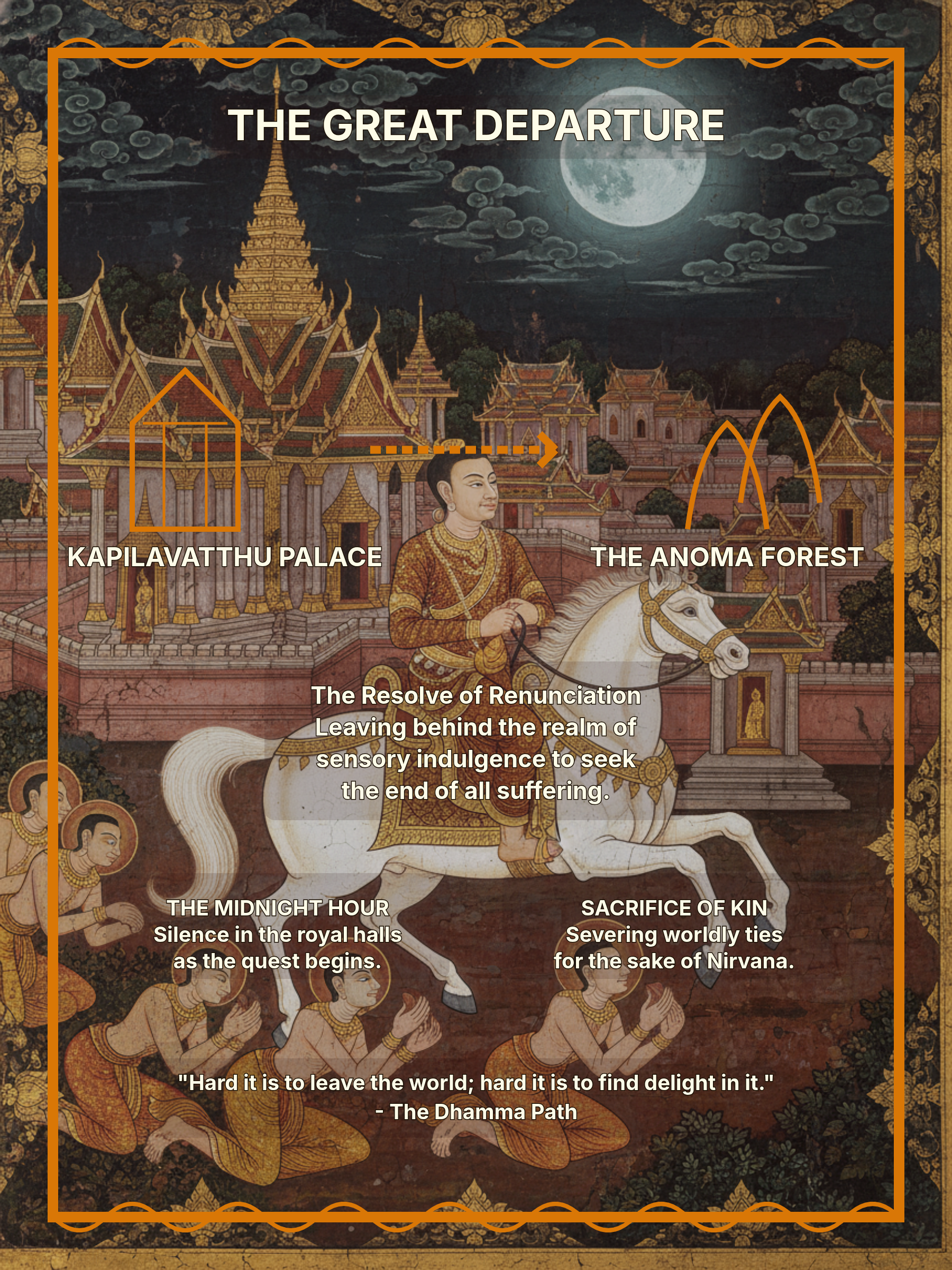
The Mahabhinikkhamana, or the Great Departure, marks the definitive turning point in the life of the Bodhisatta, Prince Siddhartha Gautama, and subsequently, the spiritual history of the world. At the age of twenty-nine, having lived a life of unparalleled luxury and sensory gratification within the three palaces provided by his father, King Suddhodana, the Prince encountered the ‘Four Sights’—an old man, a diseased man, a corpse, and a wandering ascetic. These encounters catalyzed a profound internal crisis, shattering the illusion of permanent worldly security and highlighting the pervasive nature of Dukkha (suffering). The realization that all conditioned phenomena are subject to decay and dissolution led the Prince to recognize the futility of the householder’s life as a means to find an ultimate solution to the problem of existence.
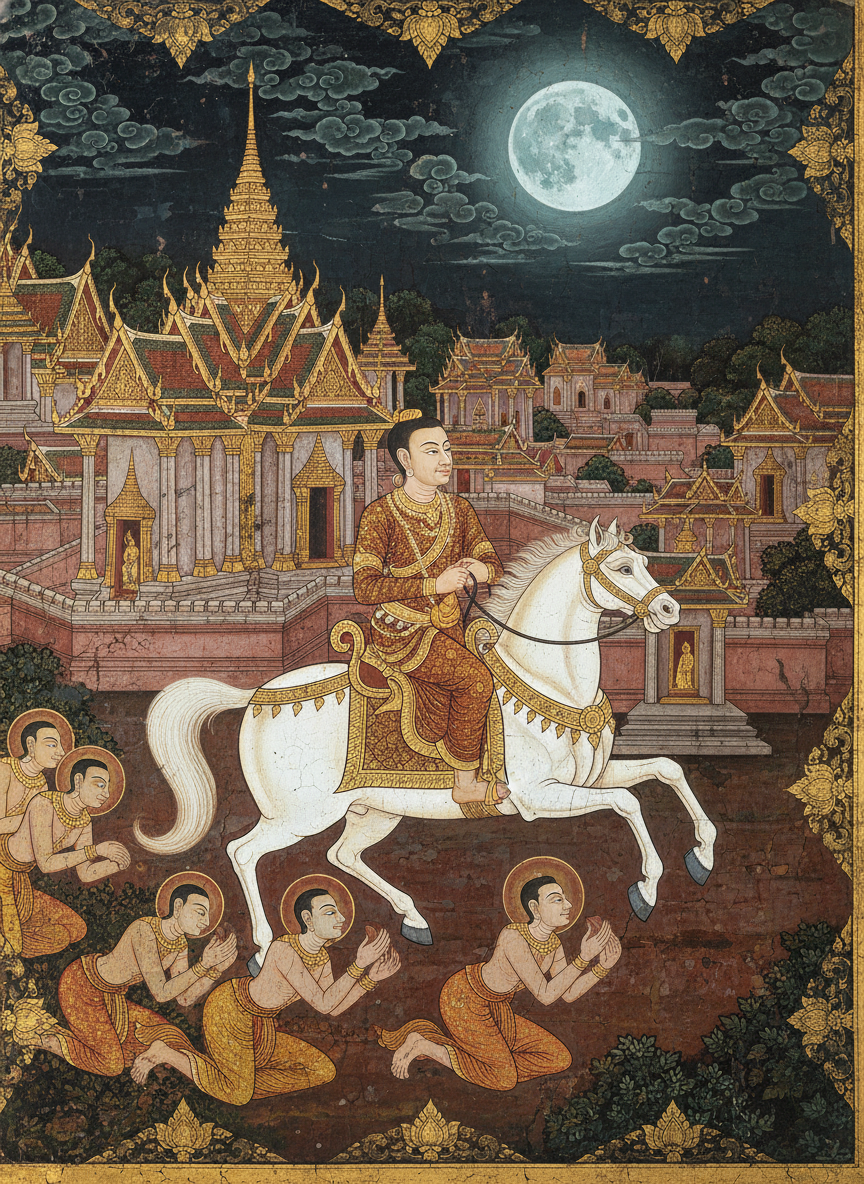
The act of departure, occurring at midnight under the constellation of Uttarashadha, is not merely a physical exit from the city of Kapilavatthu but a symbolic severance of the fetters of attachment (Samyojana). Siddhartha’s decision to leave behind his kingdom, his wife Yasodhara, and his newborn son Rahula, was an act of supreme Nekkhamma-parami (the perfection of renunciation). In Theravada doctrine, this is viewed as the ultimate sacrifice, where the personal is discarded for the sake of the universal. The renunciation was motivated by ‘Mahakaruna’—great compassion—not only for his kin but for all sentient beings trapped in the beginningless cycle of Samsara. By abandoning the crown, he sought the deathless state (Amata-dhamma) that lies beyond the reach of aging, illness, and death.
Escorted by his loyal groom Channa and mounted on his stallion Kanthaka, the Prince crossed the river Anoma, where he severed his hair and exchanged his royal silks for the simple saffron-colored robes of an ascetic. This transition from the palace (a metaphor for the ‘kama-loka’ or realm of desire) to the forest (the ‘aranna’ or site of spiritual labor) represents the shift from the outward search for happiness to the inward cultivation of wisdom and discipline. It is the archetype of the Buddhist path: the recognition of suffering, the abandonment of its cause, and the unwavering resolve to realize liberation.
The Great Renunciation: Crossing the Anoma
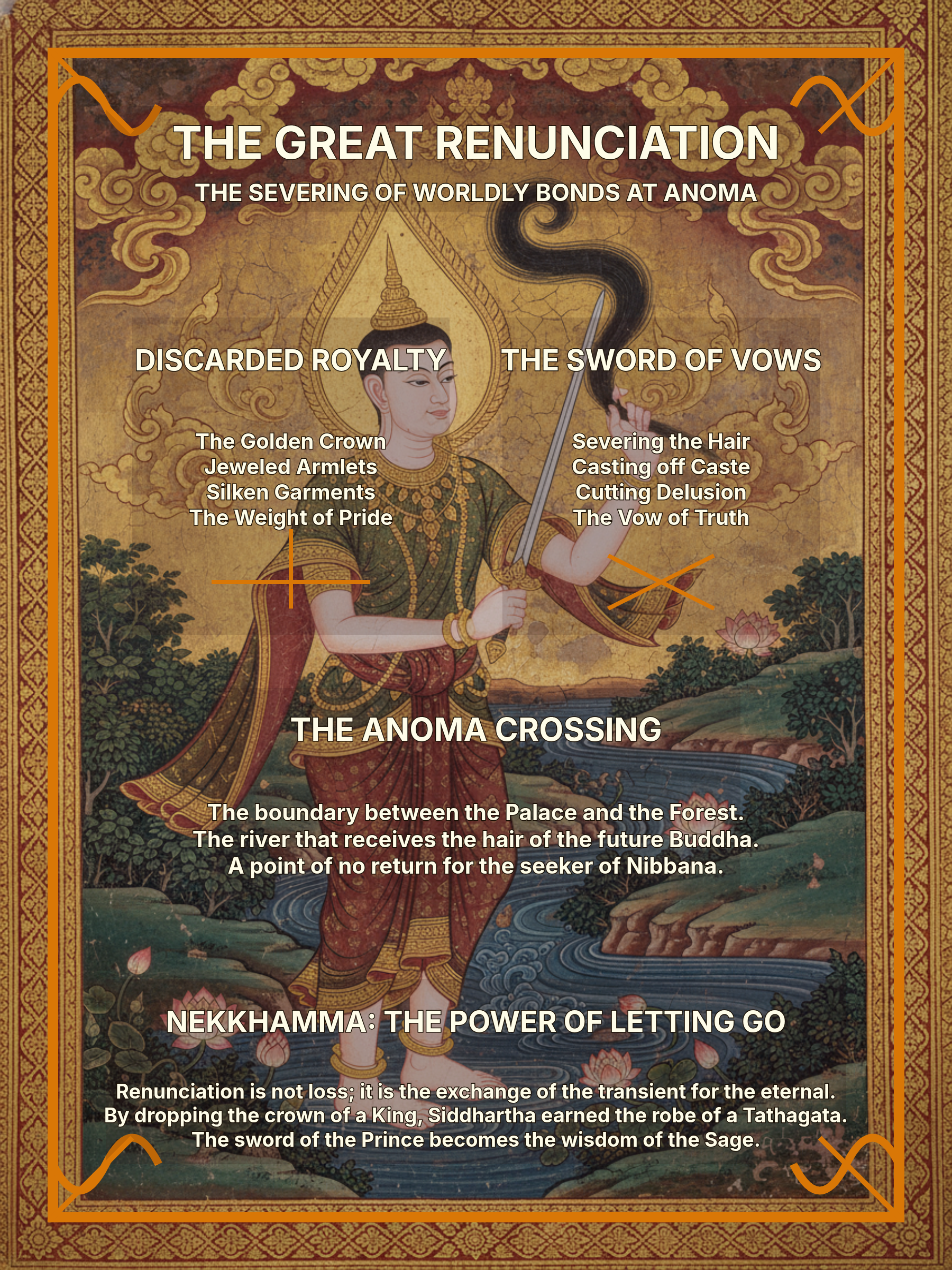
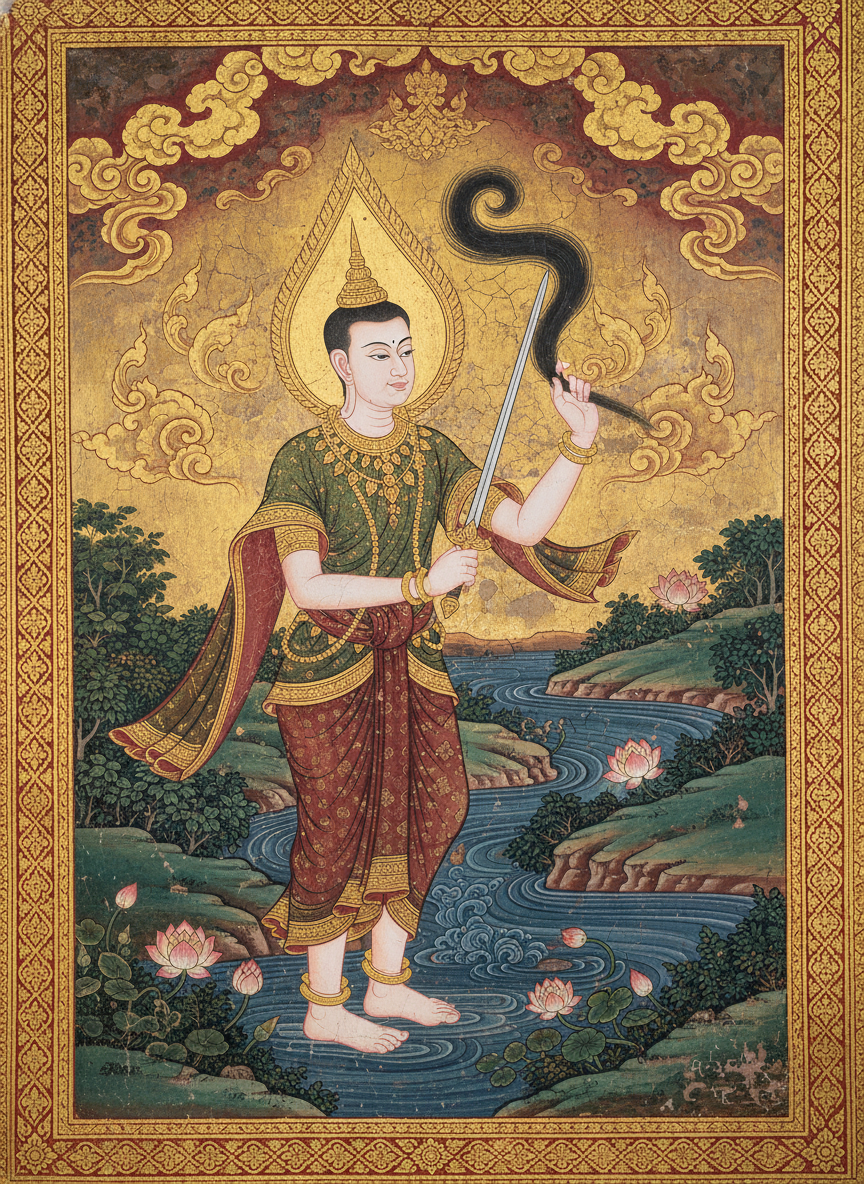
The Transition from Prince to Ascetic
The Great Renunciation (Mahabhinishkramana) represents the most pivotal transition in the biography of the Buddha, marking the departure from the householder’s life (Gihi-vasa) into the homeless life (Anagariya). This act is not merely a physical departure from the Sakyan capital of Kapilavatthu but a profound internal rupture with the cycles of Craving (Tanha) and Attachment (Upadana). Upon reaching the banks of the River Anoma, which translates to ‘Illustrious’ or ‘Glorious,’ Prince Siddhartha performed the ritual actions that finalized his commitment to the quest for the Deathless (Amata-dhamma). The river serves as a topographical boundary between the world of political power, sensory gratification, and social obligation, and the wilderness of asceticism, contemplation, and radical self-inquiry. In the Theravada tradition, this moment is steeped in symbolic gravity. The Prince, having witnessed the Four Great Sights (the old man, the sick man, the corpse, and the wandering ascetic), realized that the palace walls offered no protection against the inherent suffering (Dukkha) of old age, sickness, and death. Thus, the renunciation is the logical conclusion of an awakened conscience that can no longer find rest in the transient. The act of cutting the hair with a sword is the central iconographic motif of this scene. In the cultural context of ancient India, long, well-groomed hair was a symbol of nobility, caste status, and virility. By severing his hair, Siddhartha was not only discarding his physical beauty but also his identity as a Kshatriya prince and his place within the social hierarchy. It was a declaration of becoming an ‘outcaste’ to the world’s standards in order to seek the Noble Path (Ariya-magga). The sword, in this context, serves as a precursor to the Sword of Wisdom (Panna) which later, under the Bodhi tree, would sever the roots of the Three Unwholesome Roots: Greed (Lobha), Hatred (Dosa), and Delusion (Moha). Accompanying this act was the discarding of royal ornaments and the crown. These objects are the crystallizations of sensory desire and worldly prestige. To cast them aside on the riverbank is to recognize that no amount of gold or status can provide a permanent refuge from the existential flux of Anicca. The presence of the faithful groom Channa and the horse Kanthaka underscores the loneliness of the spiritual journey; despite their devotion, the Prince must cross the threshold into the unknown alone. This scene at the Anoma River is the ultimate archetype of Nekkhammabarami (The Perfection of Renunciation). It teaches the seeker that the path to liberation requires a ‘Great Sacrifice’—the willingness to let go of the familiar, the comfortable, and the self-defining narratives of the ego. It is only when the hands are emptied of royal jewels that they are free to receive the alms-bowl of the wandering monk, and eventually, the ultimate fruit of Nibbana. This event is the birth of the Bodhisatta’s active ministry to end the suffering of all sentient beings, signifying that the highest love for the world is found through the detachment from its fleeting allurements.
The Great Exchange: Material Wealth vs. Spiritual Poverty
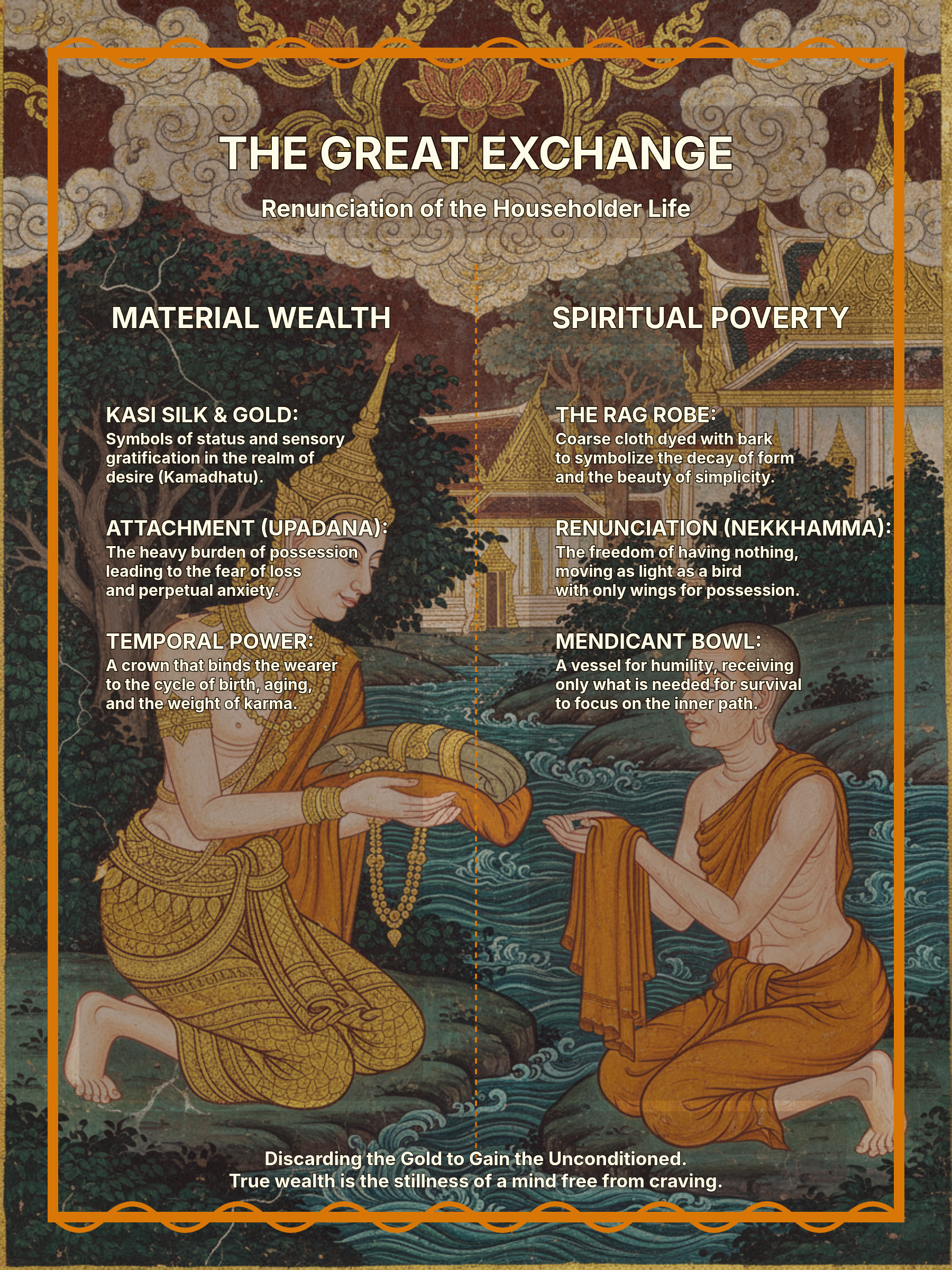
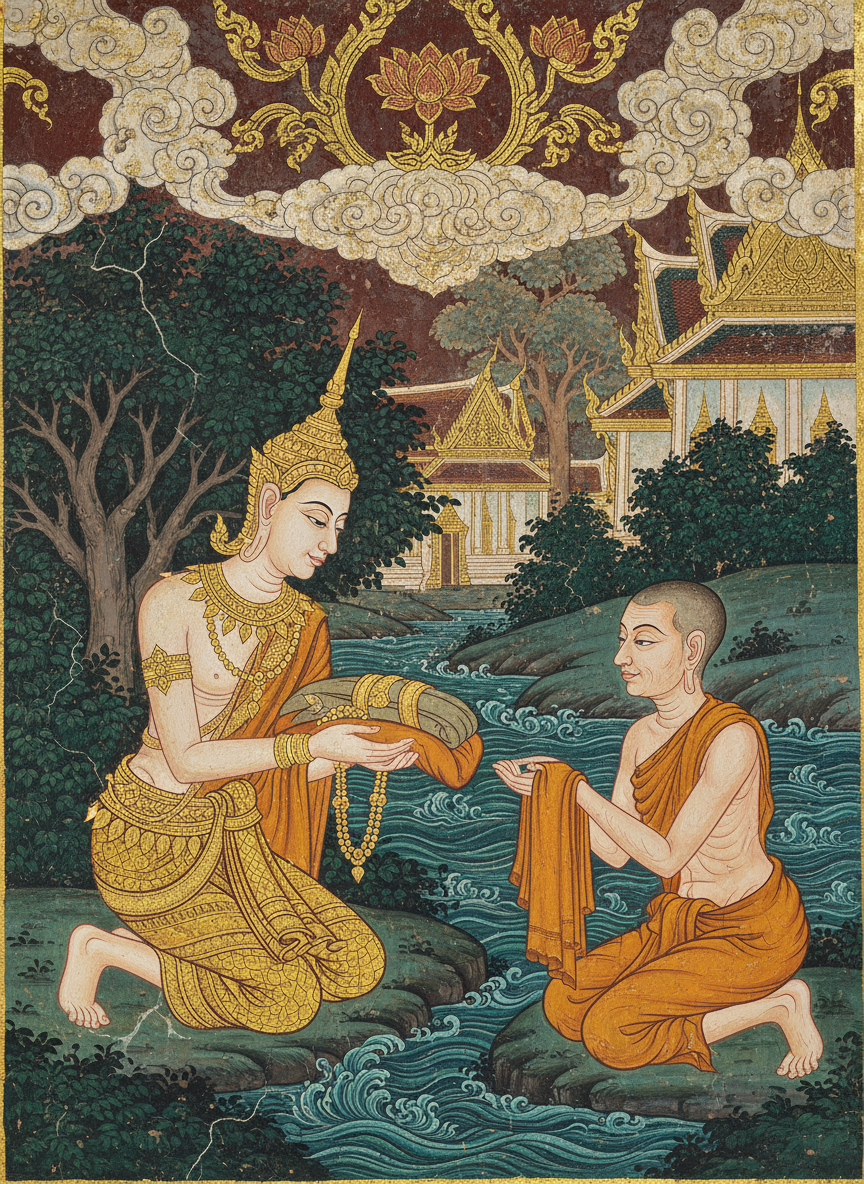
The Transformation of the Bodhisatta
The Great Exchange, traditionally known as the Pabbajja or the ‘Going Forth,’ signifies the profound ontological shift from the householder life to the homeless life. Prince Siddhartha Gautama, upon witnessing the Four Sights and recognizing the inherent instability of the Saṃsāric condition, realized that material abundance offered no protection against the inevitability of aging, sickness, and death. His royal robes, woven from the finest Kasi silk and adorned with intricate threads of gold, were not merely garments but symbols of his status within the realm of Kamadhatu (the desire realm). They represented the pinnacle of material success, sensory gratification, and social obligation. By discarding these for the coarse, saffron-dyed rags (Pansukula) of a forest mendicant, the Bodhisatta enacted a radical rejection of the self-identity construct (Sakkaya-ditthi). This state, often mislabeled as ‘Spiritual Poverty’ by the uninstructed, is in the Dhamma understood as the shedding of heavy burdens (Ohita-bharo). The coarse cloth, often stitched together from discarded shrouds or cemetery remains, serves as a constant meditation on impermanence (Anicca) and the impurity of the body (Asubha). It is the uniform of the Ariyan seeker, a barrier against vanity, and a bridge to the deathless. Material wealth is fundamentally characterized by ‘upadana’ (clinging) and ‘tanha’ (craving), which inevitably culminate in ‘dukkha’ (suffering) when the objects of desire inevitably decay. In stark contrast, the mendicant’s bowl and simple robe signify ‘alobha’ (non-greed) and ‘appiccha’ (fewness of wishes). This exchange is the foundational gesture of the Sangha, establishing the path of renunciation (Nekkhamma) as the primary vehicle for the cessation of suffering. The Bodhisatta’s transition demonstrates that the path to ultimate liberation requires the total abandonment of the ‘I’ and ‘Mine’ mentality, replacing the fleeting security of temporal power with the unshakeable peace of the Middle Way. Through this exchange, the Prince moved from the bondage of gold to the liberation of the void, showing all sentient beings that true riches lie in the purification of the mind rather than the accumulation of external possessions.
Scene 4: The Sylvan Departure
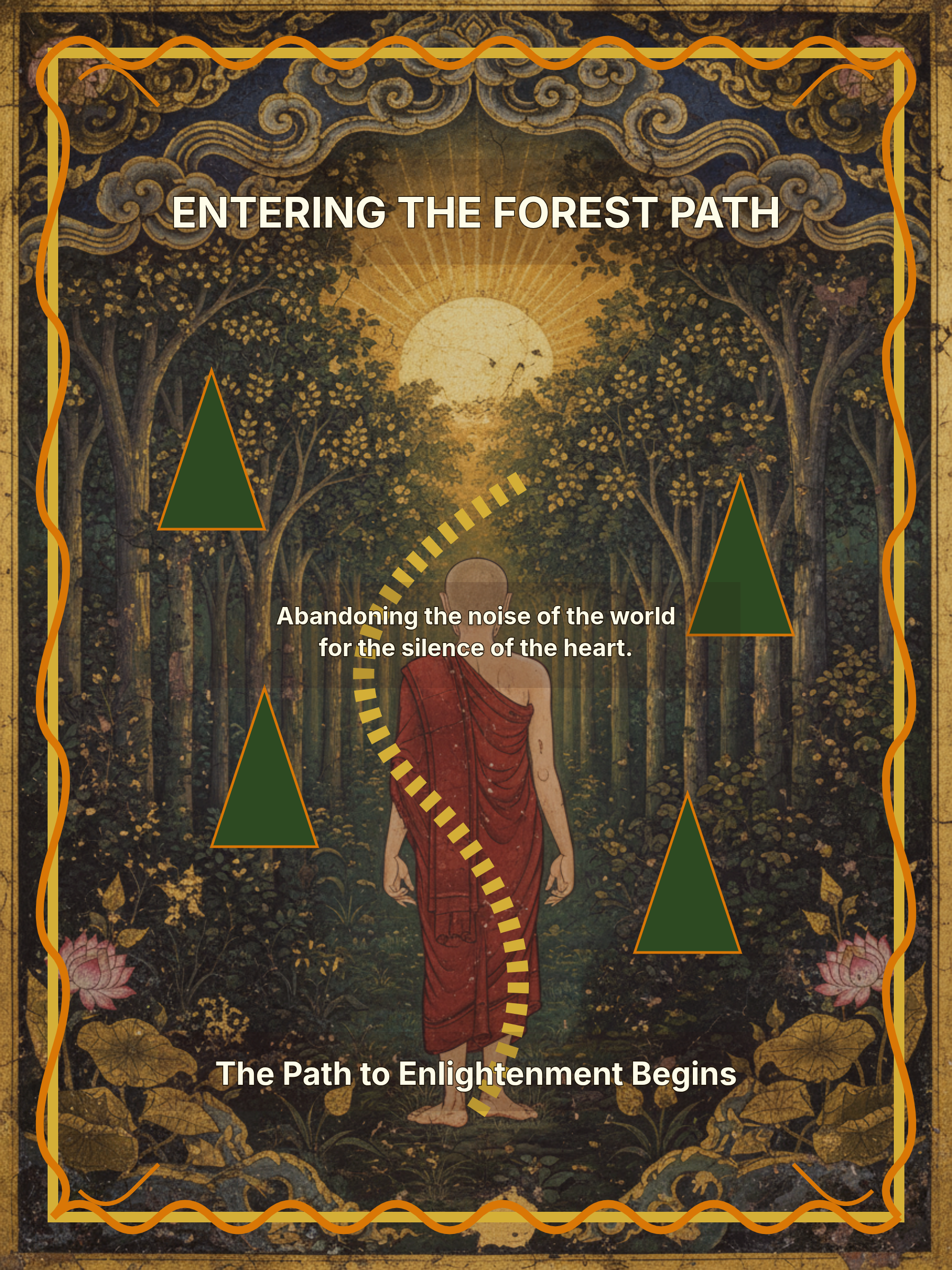
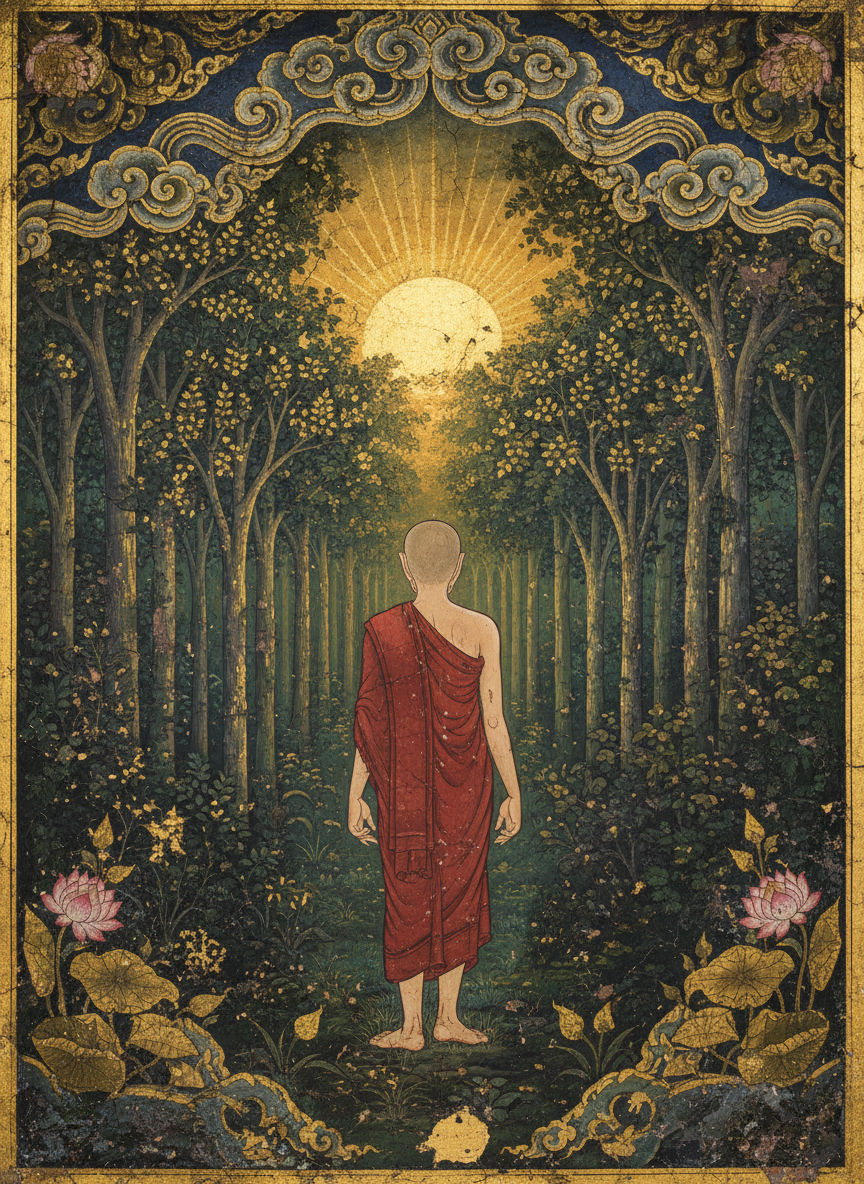
The Araññavāsa Initiation
In the sacred geography of the Theravada tradition, the transition from the village (gāma) to the wilderness (arañña) represents the definitive rejection of the mundane cycle of craving and the initiation of the ascetic’s journey toward the Unconditioned. This ‘Entering the Forest Path’ is not merely a physical relocation but an ontological pivot—a deliberate cultivation of Kaya-viveka (physical seclusion) intended to serve as the vital foundation for Citta-viveka (mental seclusion). As detailed in the Aranyaka Sutta and the various discourses on the Dhutanga (austere practices), the forest is the primordial crucible of the Dhamma. It is a space where the sensory bombardments of the social world are replaced by the raw, unadorned manifestations of nature, forcing the practitioner to confront the internal movements of the mind without the mask of social identity. The winding path depicted in this contemplation represents the Middle Way (Majjhima Patipada)—a trajectory that avoids the extremes of worldly indulgence and self-mortification. By entering the forest, the seeker follows the footprints of the Tathagata, who himself sought the shelter of the Bodhi tree far from the palaces of Kapilavatthu. This movement symbolizes ‘Nekkhamma’ (renunciation), the heart of the second factor of the Noble Eightfold Path, Samma Sankappa (Right Intention). Within the silence of the trees, the practitioner begins the arduous task of Satipatthana—the Four Foundations of Mindfulness—observing the breath, the feelings, the consciousness, and the mental qualities as they arise and vanish in the stillness. The forest path is therefore the transition from the noise of ignorance to the silence of wisdom, where the practitioner learns that the true ‘forest’ to be cleared is the dense thicket of defilements (kilesas) that have overgrown the path to liberation. To enter this path is to commit to the taming of the wild mind, transforming it from a site of chaotic desire into a temple of equanimity and insight. It is here, under the canopy of solitude, that the seeds of Samadhi are sown and the light of Paññā (wisdom) is allowed to flicker and grow into the radiant sun of Enlightenment.